Review of Avangard Leasing CJSC's presentation at the BCSE
On 30 September 2021 the Belarusian Currency and Stock Exchange (BCSE) held an online seminar titled “Meet the issuer. Company presentation. Why investors buy AVANGARD LEASING bonds”.
The seminar, held as part of the activities of the Association of Securities Market Participants of Belarus, was opened by Boris Fridman, deputy chairman of the BCSE management board. He introduced the participant, Avangard Leasing, as an example of an issuer that strives to be as transparent as possible in its work on the stock market.
A few words were said about the exchange bond market. As of 1 September 2021, 468 bond issues by 130 issuers were admitted to trading on the exchange, 18% of them National Bank bonds. The remaining 380+ issues come from other issuers, so you can find a company of any reliability level and industry. Level 1 includes the Ministry of Finance and the National Bank. Three issuers are admitted to Level 2, one of them the seminar's guest, Avangard Leasing.
In 2021 exchange bond trading volume is approaching USD 6 billion. BYN 235 million was placed on the primary market, of which BYN 113 million was raised by corporate issuers. The secondary market figures are more impressive: turnover has already exceeded BYN 5.5 billion, of which 130 million is trading in corporate bonds. Avangard Leasing is one of the most active issuers and has been on the bond market since 2010. Over the past 10 years the company has registered 36 bond issues, 16 of which have been repaid on time and in full. It is the first company whose bonds were moved from the unlisted securities list to the Level 2 list. Since 21 July 2021 the company's exchange bonds have been listed, and there are now 8 issues on the list. Avangard Leasing CJSC is a member of the Association of Securities Market Participants.

Anton Andrenko, director and co-owner of Avangard Leasing CJSC, spoke about the company's business, client base, leasing portfolio and the structure of its borrowed capital for 2021. First of all he answered the question: “Why do people buy Avangard Leasing bonds? Because the company is understandable and transparent, always offers investors attractive terms and always meets its obligations — and has done so for more than 10 years. With the company you can look far ahead — 10 to 20 years — and understand what will happen to your money over that time. The company's longest loan matures in 2041.”
Avangard Leasing CJSC issuer presentation
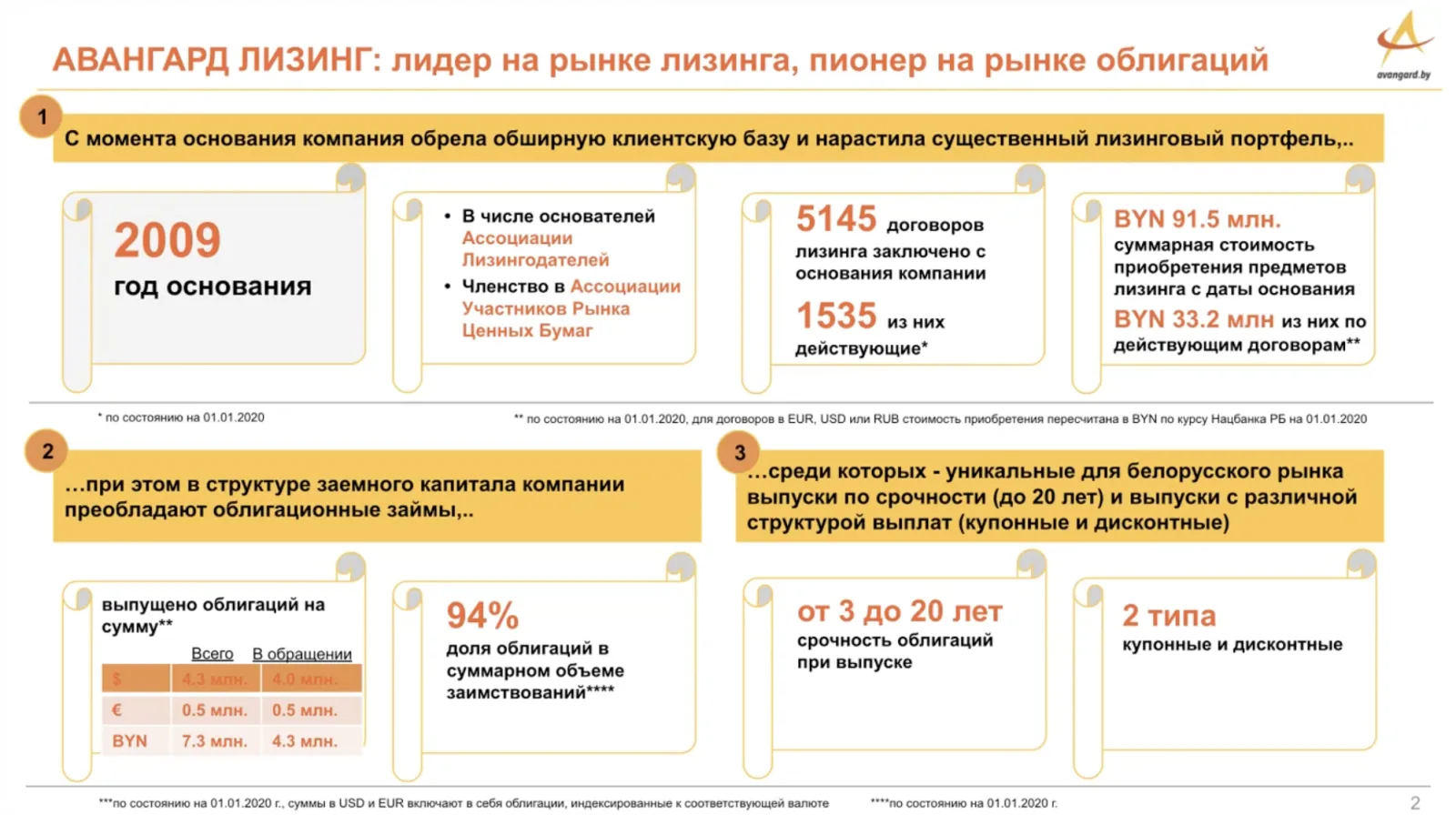
The presentation was prepared for the company's 10th anniversary. More detailed information on the company's activities is published quarterly on its website, in a broader format than the law requires. The company is very open and always has answers to investors' questions. Over its history it has signed more than 5,000 contracts and invested the equivalent of more than USD 60 million.
Leasing requires capital. The company's capital structure includes equity and funds borrowed on the market. 100% of its borrowings are public: either bond loans through the exchange or electronic loans, which became available a few years ago.
How the leasing business works and what loans are raised for
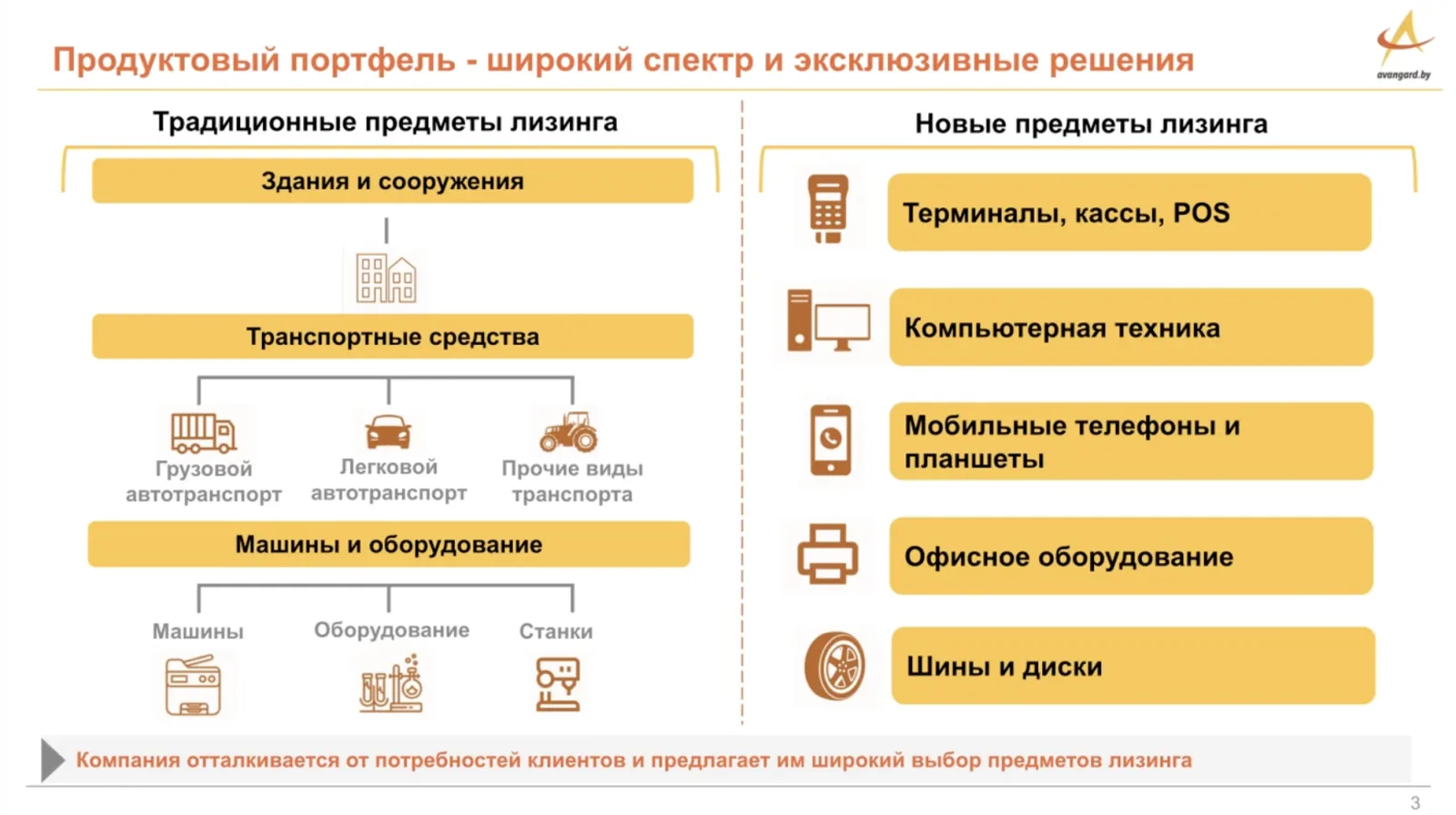
Leasing is renting with an option to buy. Long-lived assets are purchased and leased out with the possibility of buying them at a pre-agreed price — from small items (terminals, cash registers, phones) to expensive property (real estate, cars, equipment). Being “omnivorous” is at the heart of the company, for which:
a) there are no deals too small (from the equivalent of USD 100);
b) there are no insignificant clients.
The core client base is small and medium-sized businesses (95%) and individuals. The client base keeps growing and needs funding for new ideas.
Top management and their qualifications
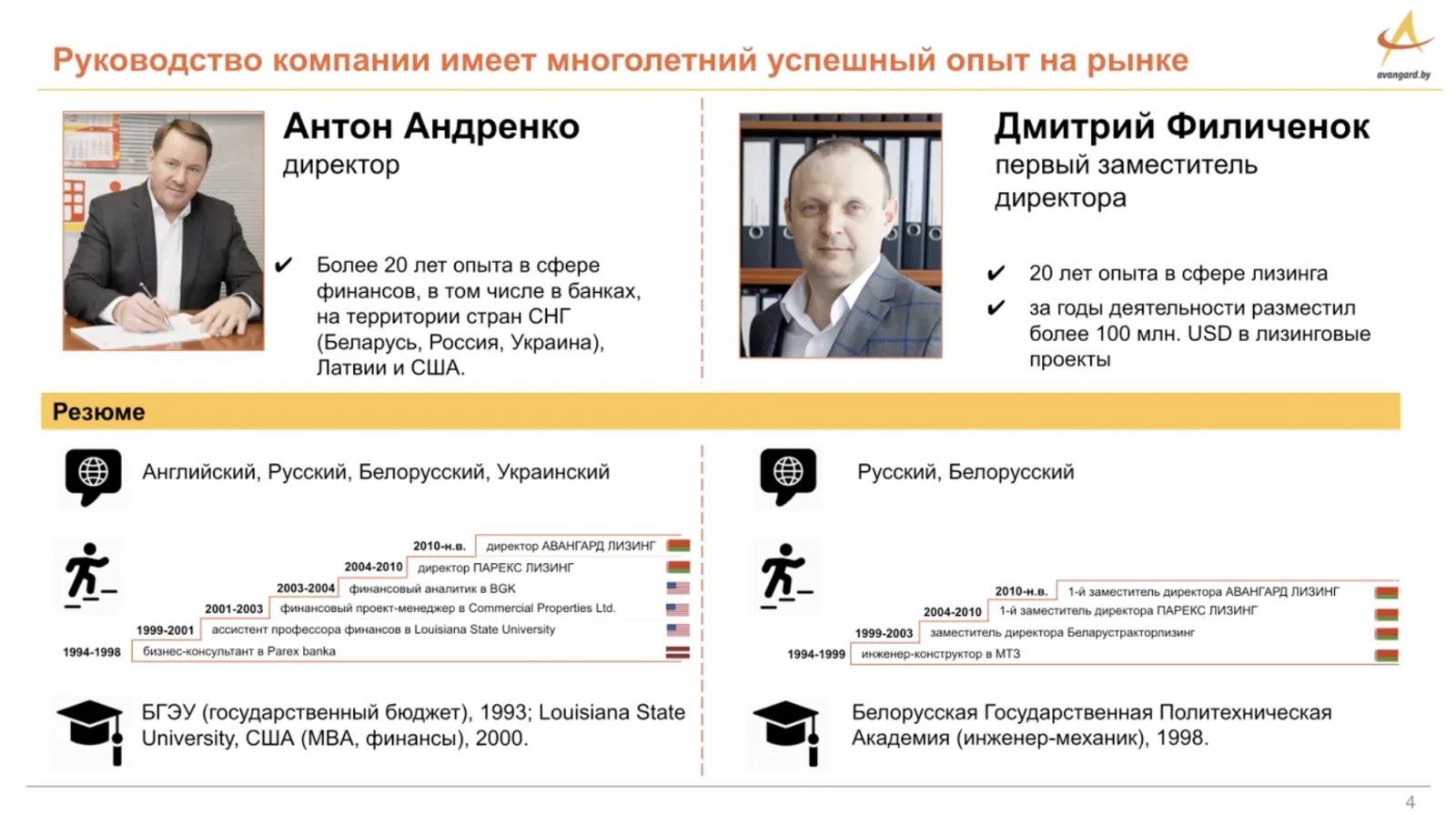
Anton Andrenko, director and co-owner, has worked in leasing since 2004 and has a relevant financial education and experience abroad. His partner Dmitry Filichenok is a veteran of Belarusian leasing with more than 25 years in the industry. He knows the local market very well and has seen all its ups and downs.
Key aspects of Avangard Leasing's development in the Belarusian market
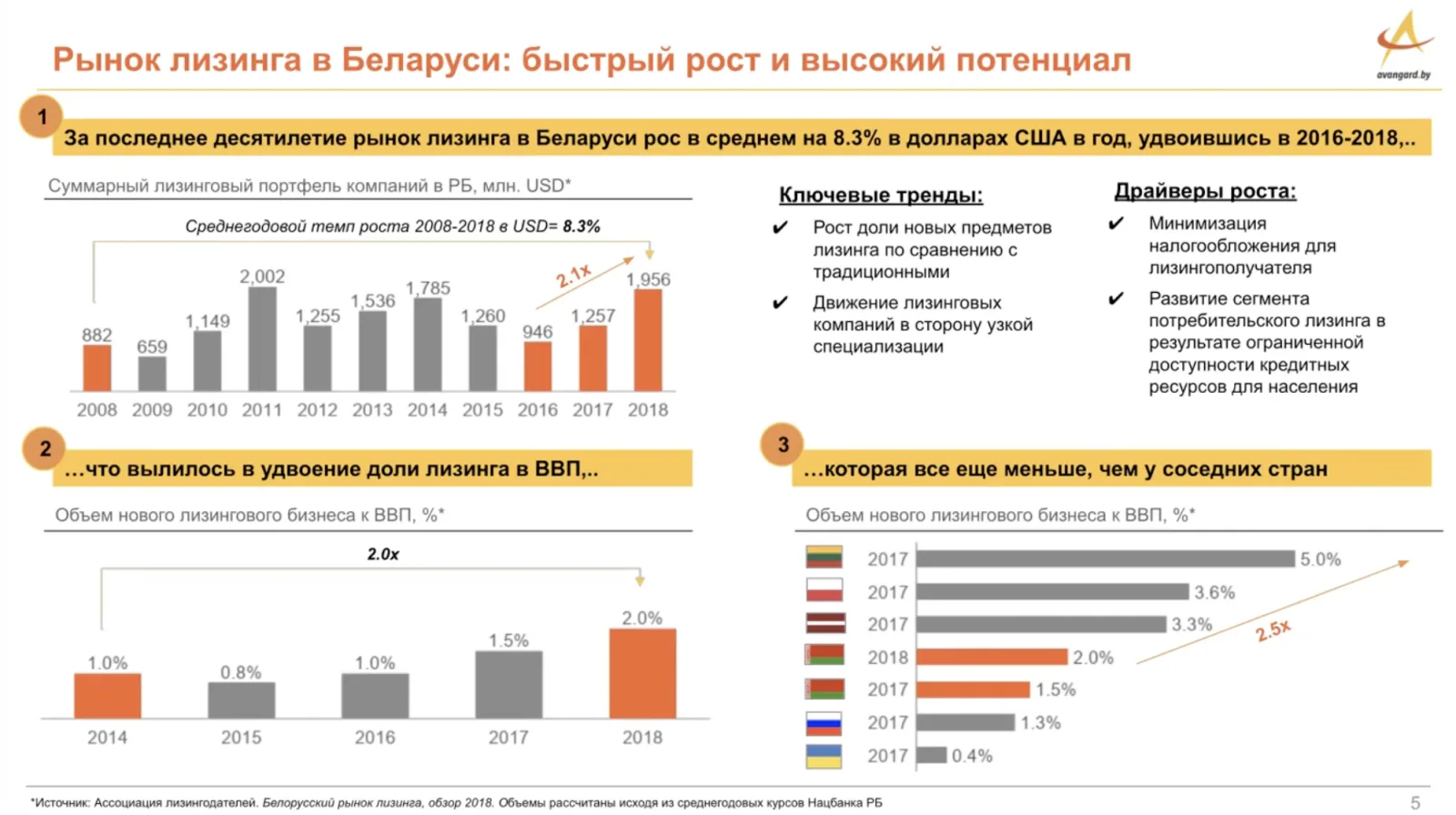
Over the past 15 years the Belarusian leasing market has fluctuated but kept growing. For a number of reasons financial institutions pay more attention to leasing than to traditional lending, and banks are moving into leasing because it lets them control risks. Detailed information on lessors is available on the relevant website. Avangard Leasing grows together with the market, and its portfolio size correlates with market movements. The key factor is the availability of funding. Since 2010, when the first bond issue was placed, the entire loan portfolio, previously made up of bank loans, has gradually been replaced by public borrowings, which bring advantages, stabilise the financial position and help control risks.
Experience with individuals
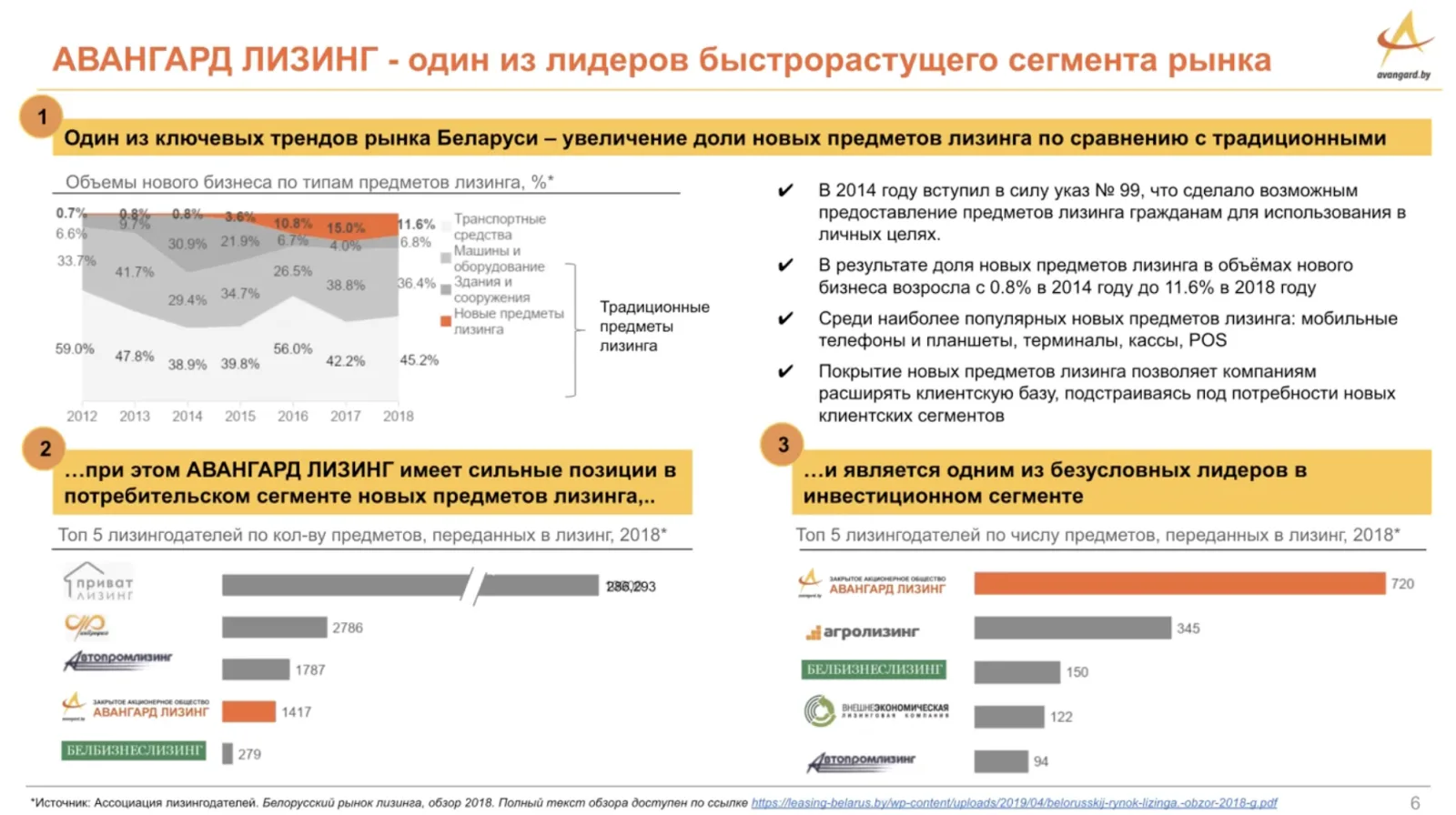
The company has had good experience with deals with individuals, going through the full cycle from placing funds to collecting debts, including bad ones. Analysing its experience in 2017–2019 allowed the company to step up its activity in this market. Several regional programmes are being prepared for launch, and their results will be visible in the company's statements.
A brief analysis of financial results
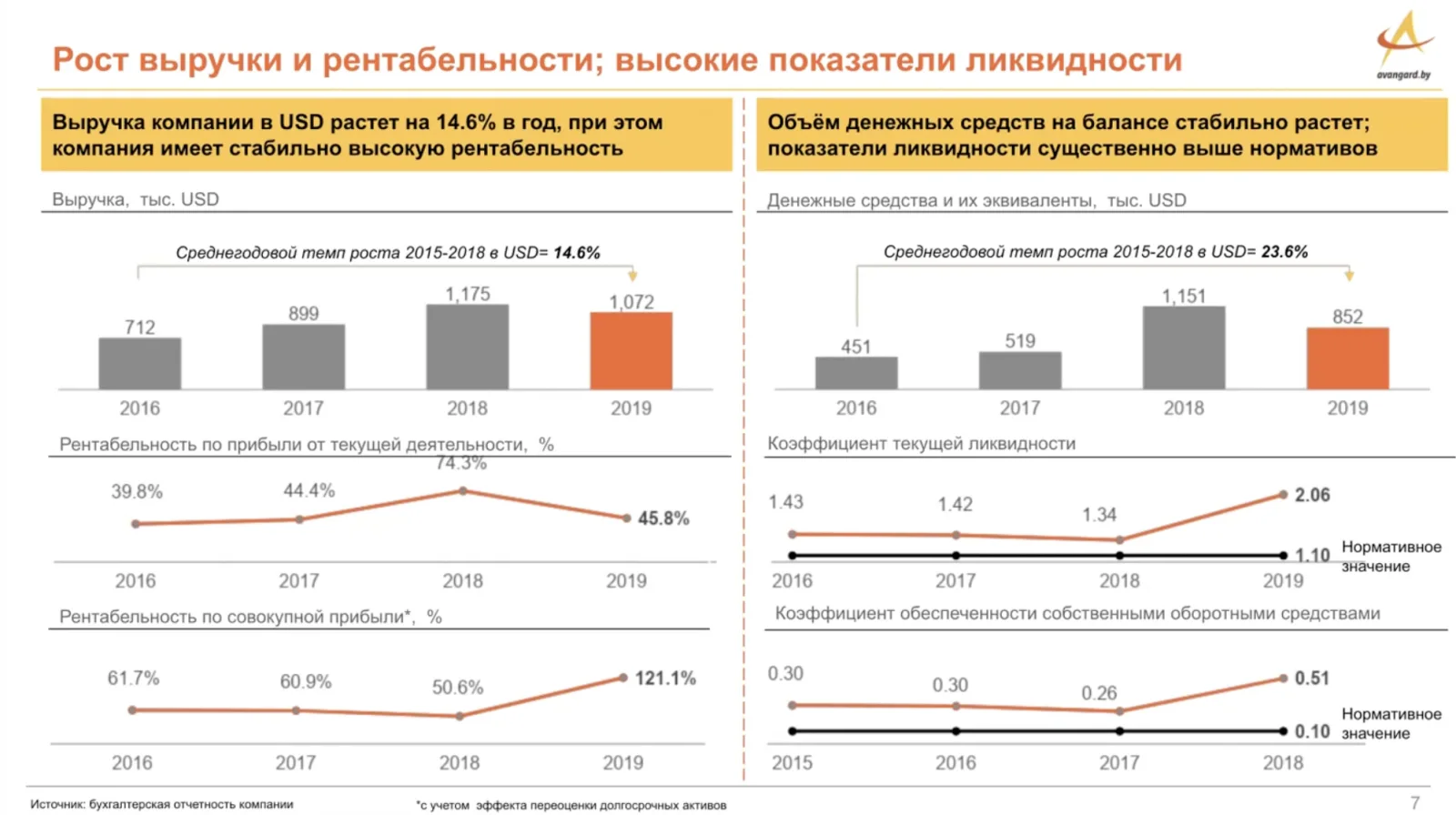
The company has shown steady growth over the last 10 years, which depends on the availability of funding — a typical caveat for Belarusian leasing. Avangard Leasing is currently the only company in Belarus funded by public borrowings. Bank loans are used only to top up working capital and cover cash gaps. Such credit lines are used very rarely, which speaks well of a company that plans its activities carefully.
Broad diversification of the leasing portfolio, investment portfolio and risk control
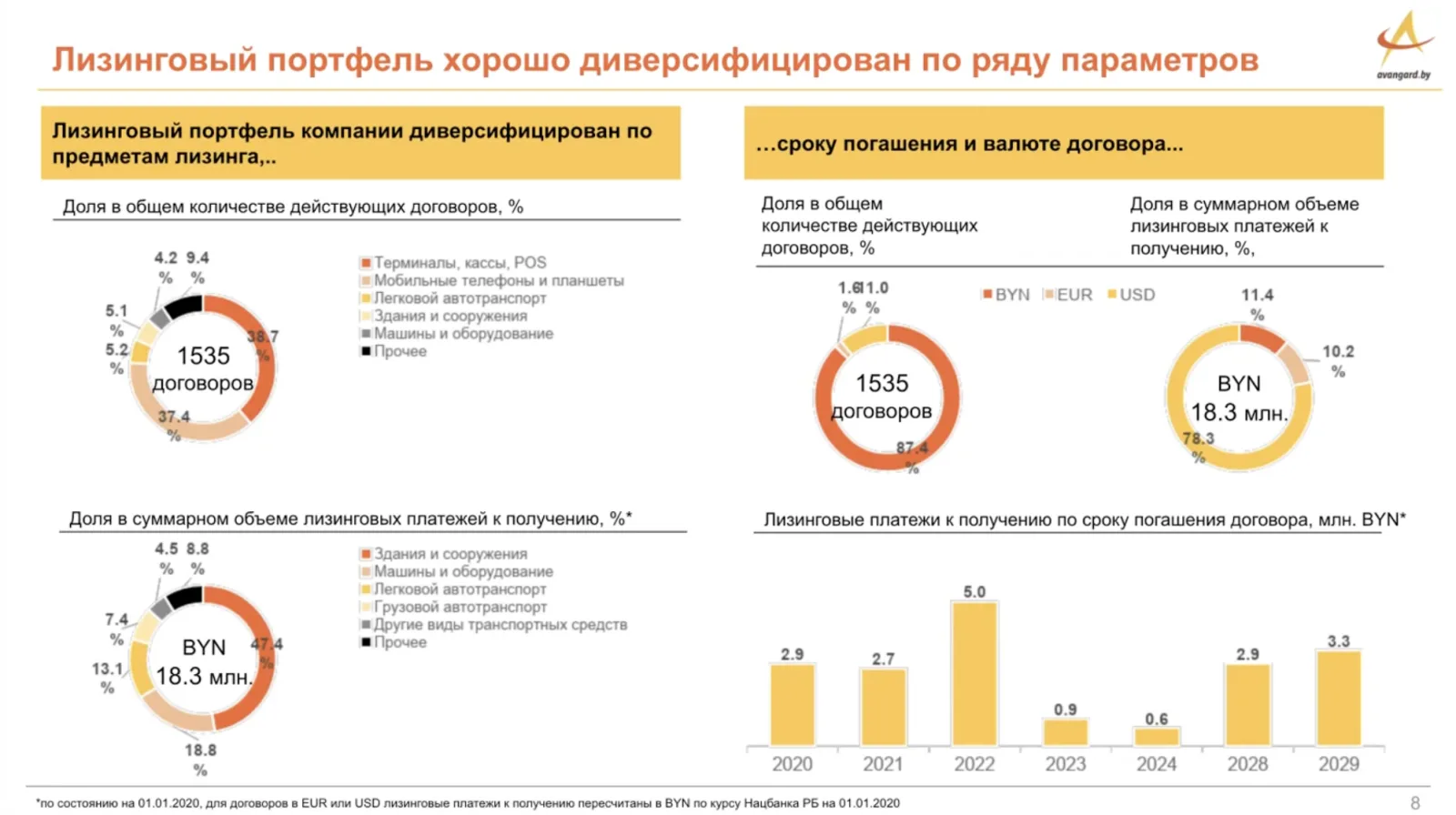
Avangard Leasing can rightly be called the most diversified leasing company in the country, both by funding sources and by the assets it buys. Most companies specialise in one type of leased asset and stick to it. Avangard Leasing does not focus on a particular asset but follows the client and their needs. This gives the company significant advantages, turning it into a centre of financial solutions and broadening its opportunities. The company works in 4 currencies (US dollar, euro, Belarusian and Russian rubles) but does not take a currency position: it places funds in the currency in which they were raised. The credit and leasing portfolio is rebalanced every quarter.
There is also geographic diversification: the company works across the whole country without branch offices.
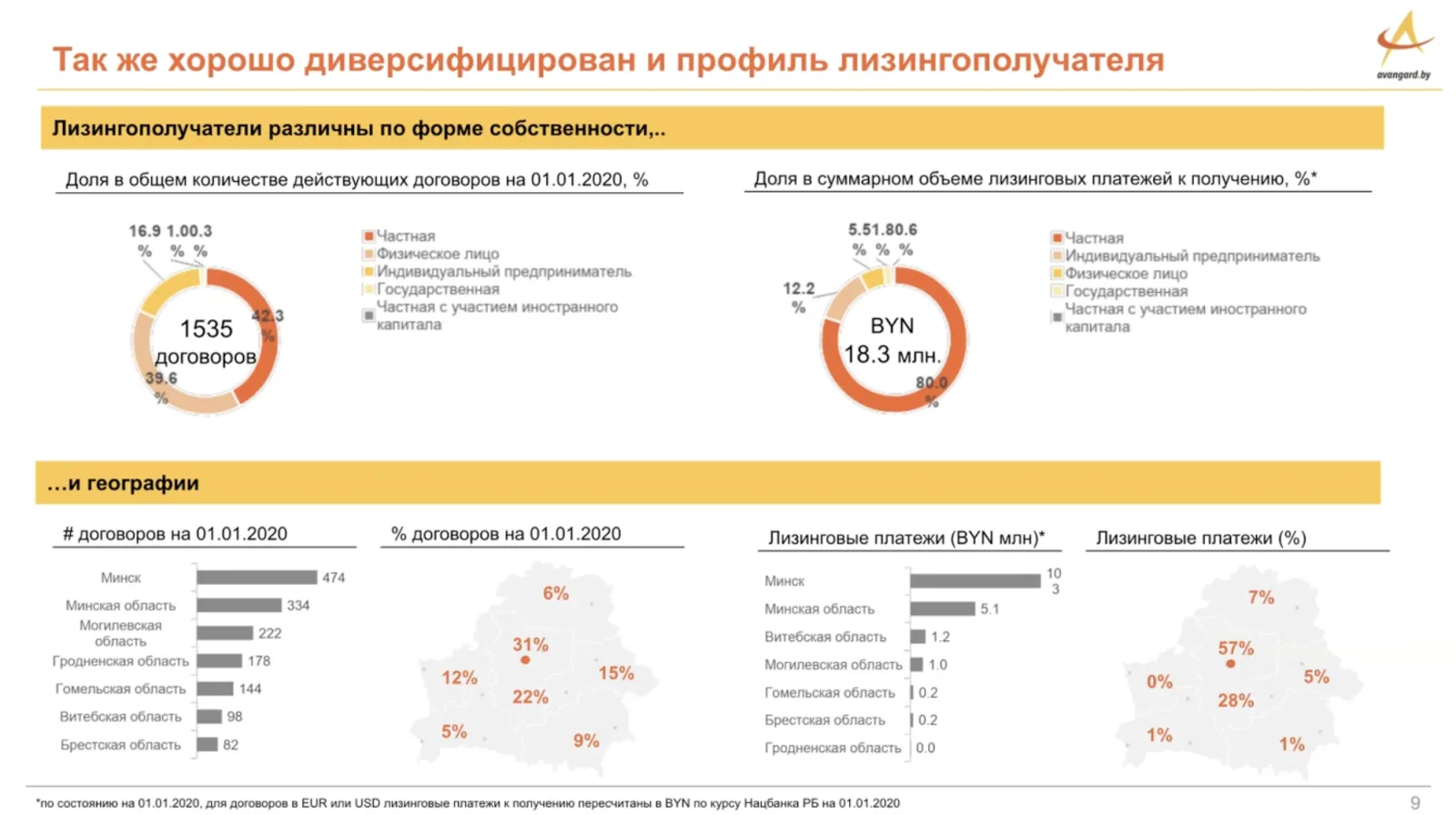
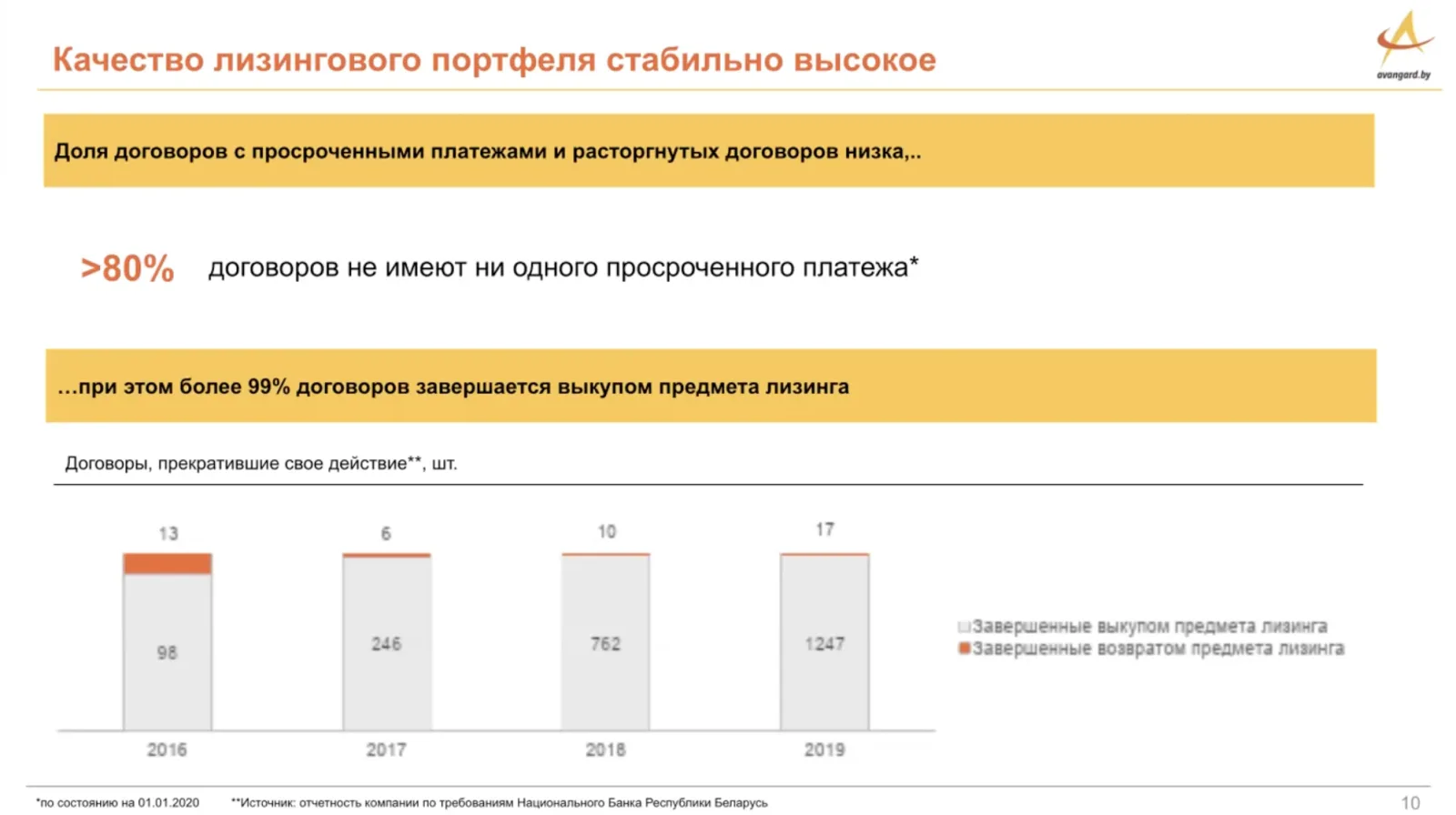
There is no dominant exposure that would put the business at risk. More than 80% of contracts have no overdue payments over the entire lease term, and bad receivables are only 2%.
Key milestones, 2009–2020
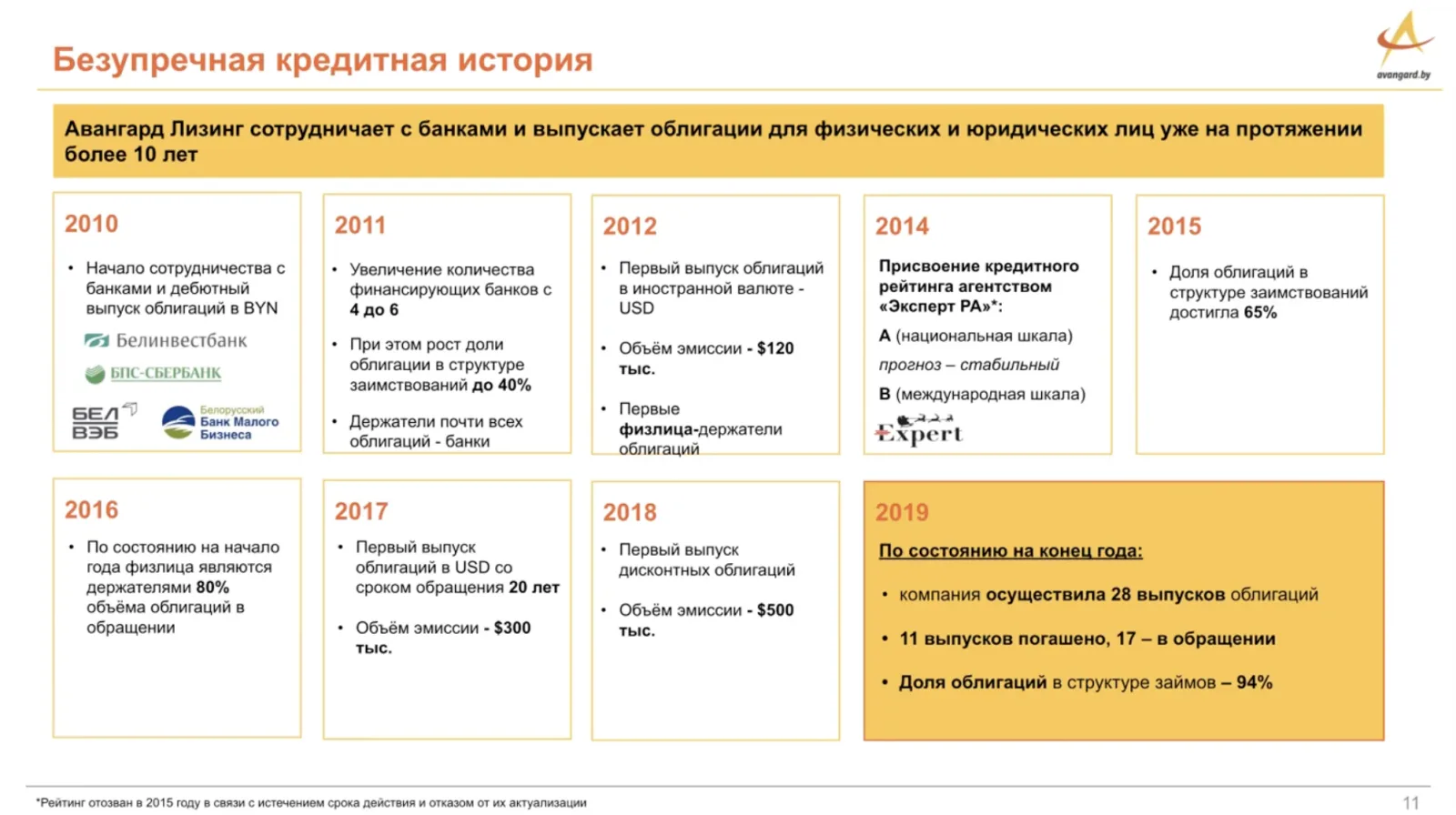
When it started out in 2010, the company wanted to raise funds both from neighbouring countries and further abroad. It was assigned the highest creditworthiness rating, but could not enter the Russian market because its volume was too small. The company had to abandon its plans for funding in Russia, but found its investors in Belarus and has not disappointed them.
Importantly, relations with investors are not one-sided. Since 2018 the company has made several discount bond issues. These turned out to be in high demand among investors who prioritise capital growth and maximum compounding. For example, the yield on an interest-bearing issue is 20, on a discount issue 27, and the difference in yield is the result of compounding.
Replacing loans with bonds and lowering the cost of borrowing
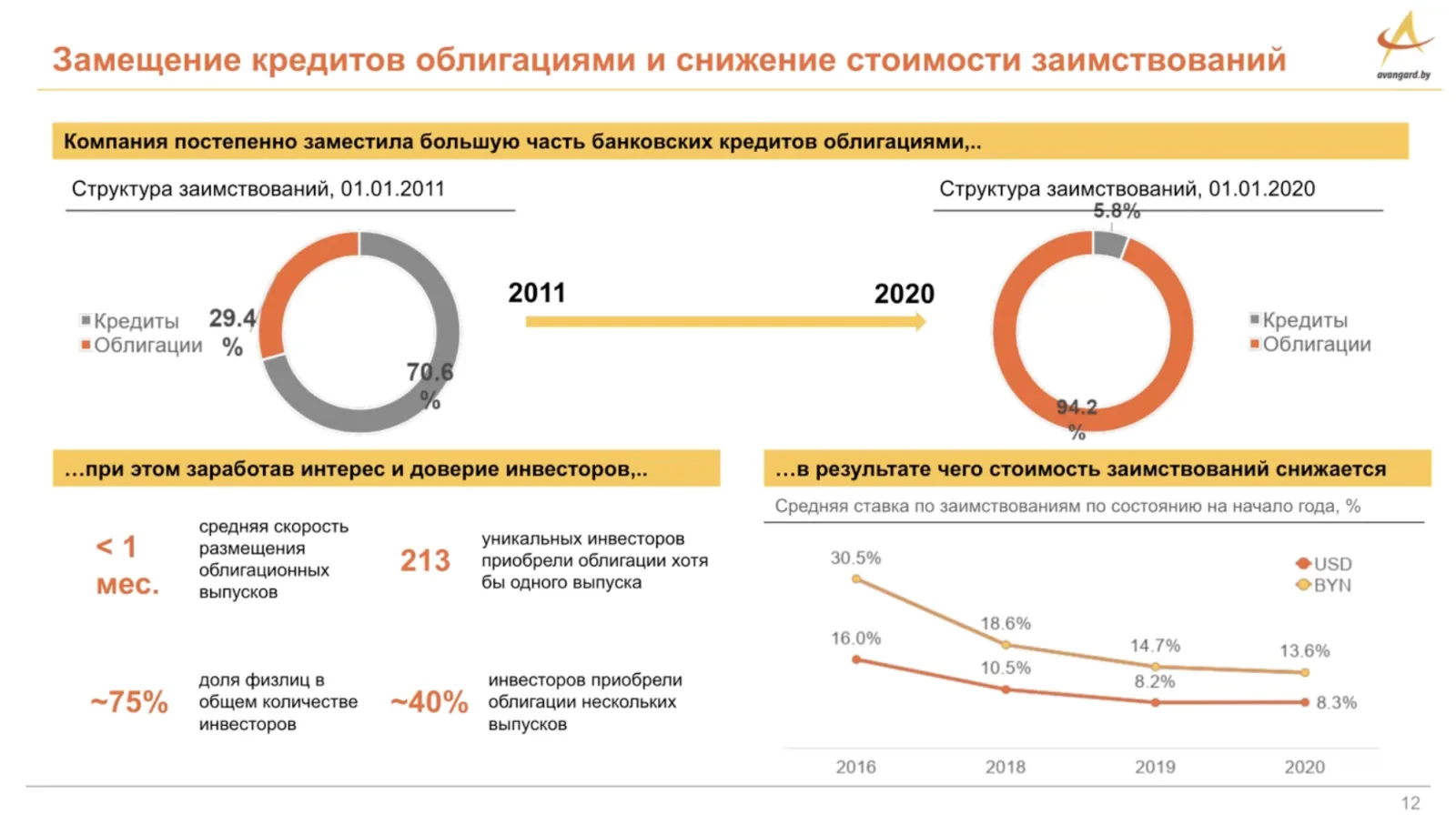
The company follows a diversification strategy: a large number of investors stabilises the funding base. The risk of banks cutting off financing led the company to end its relationships with them, and it relies on a stable investor base. Some banks have opened limits for the company and buy its bonds for their portfolios when they need liquidity; so does one insurance company. The company also has experience with foreign investors, which is very promising.
Importantly for investors, not a single loan has ever been called early because funding became cheaper. The company always meets its obligations. All issues currently on the market have a put option allowing investors to withdraw all funds within a year, which is very advantageous for them.
Strategy and key targets for 2021–2022
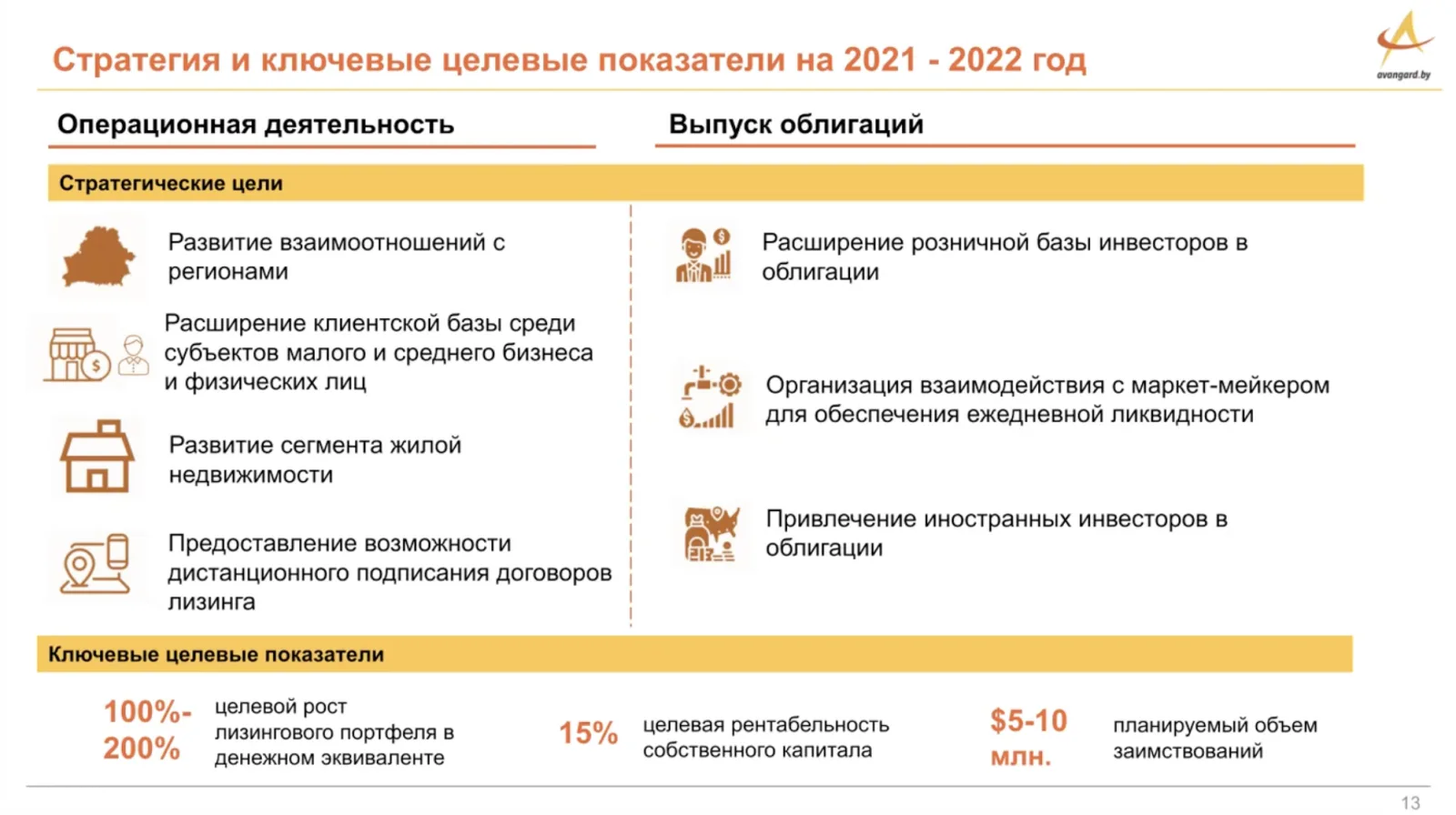
Dmitry Filichenok, deputy director and commercial director, spoke about the key priorities for the near future.
Since its founding the company has primarily worked with small and medium-sized businesses and individuals. Relations with the regions are developing actively: the company is looking for suppliers working directly in the regions, signing contracts and building business relationships with each of them. The company always starts from the needs of its lessees and grows with them. Many of Avangard Leasing's very first clients still do business with it.
In addition to standard leasing, the company is actively developing residential property leasing for legal entities. It is a specific kind of leasing that allows company owners to acquire residential property without paying out of their own pocket. Such deals are in demand even though they are large, take a long time to arrange and require significant investment.
Consumer leasing for individuals is being resumed, which will significantly diversify the company's leasing portfolio and increase deal profitability.
During the pandemic all documents are signed remotely. Individuals can do this on the company's website by filling in a credit report, which protected clients and staff from possible infection.
Anton Andrenko stressed that the company intends to move entirely to remote signing of contracts in the near future (within one to three years), without personal contact with staff. The company plans to use sellers of property as an agent network to sell the product locally and draw up lease contracts. Signing documents and receiving lease payments will thus happen without visiting an office. This will make it possible to work with remote regions and increase profitability.
The portfolio's maturity is currently around 30 months. Growing the portfolio requires constant capital raising. Talks are under way with several foreign investors, which would diversify the base and reduce risks. Planned fundraising over the next 2 years is estimated at USD 5–10 million.
Terms of the company's issues and key advantages for investors
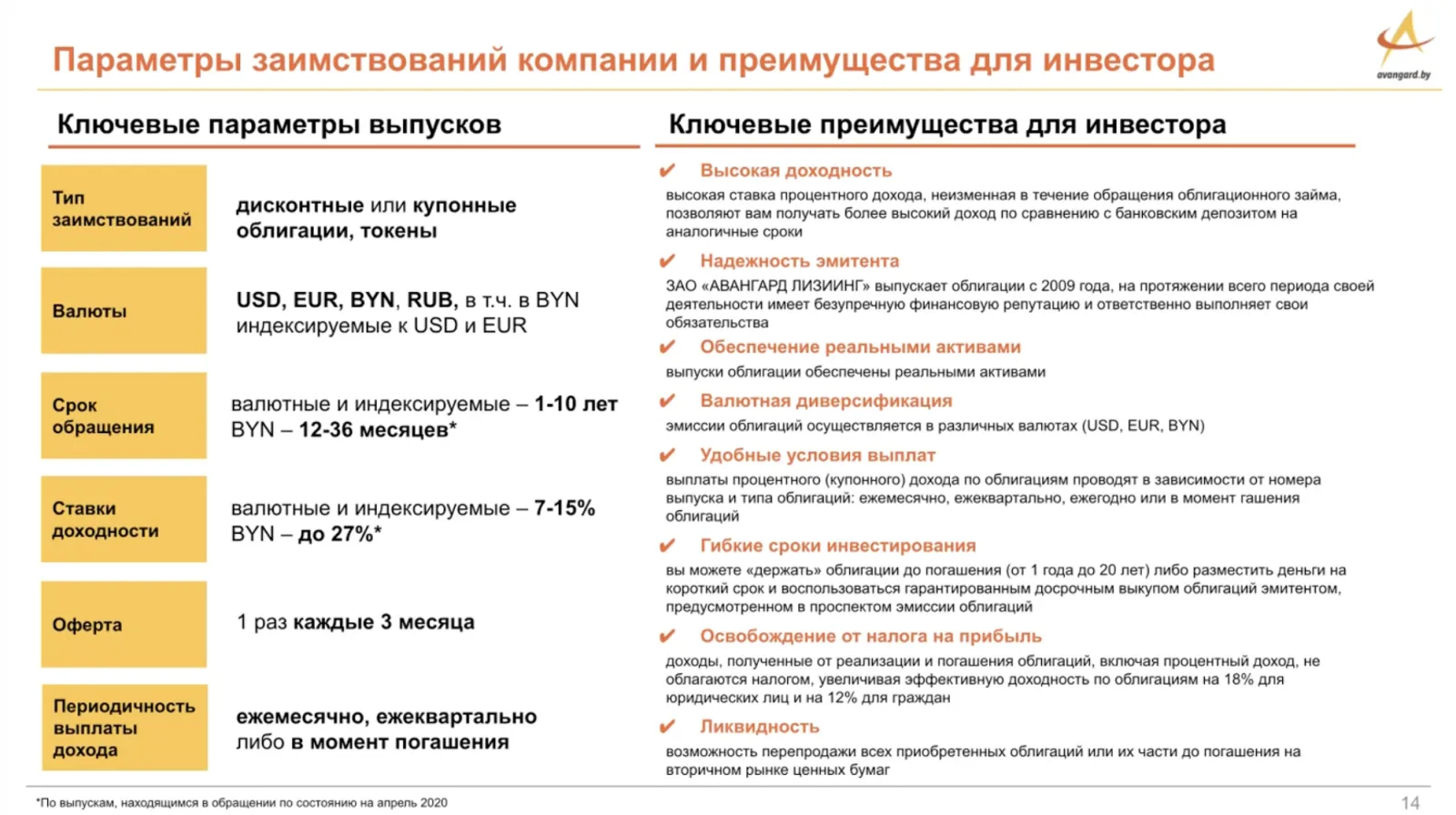
There is currently a choice of coupon and discount bonds in 4 currencies, as well as electronic obligations, or tokens. Yields are up to 27% on a discount security in Russian rubles and 5.5–15% in foreign currency; on a coupon security, 15% in Russian rubles and 8.5–10% in foreign currency.
Company growth, 2020–2021
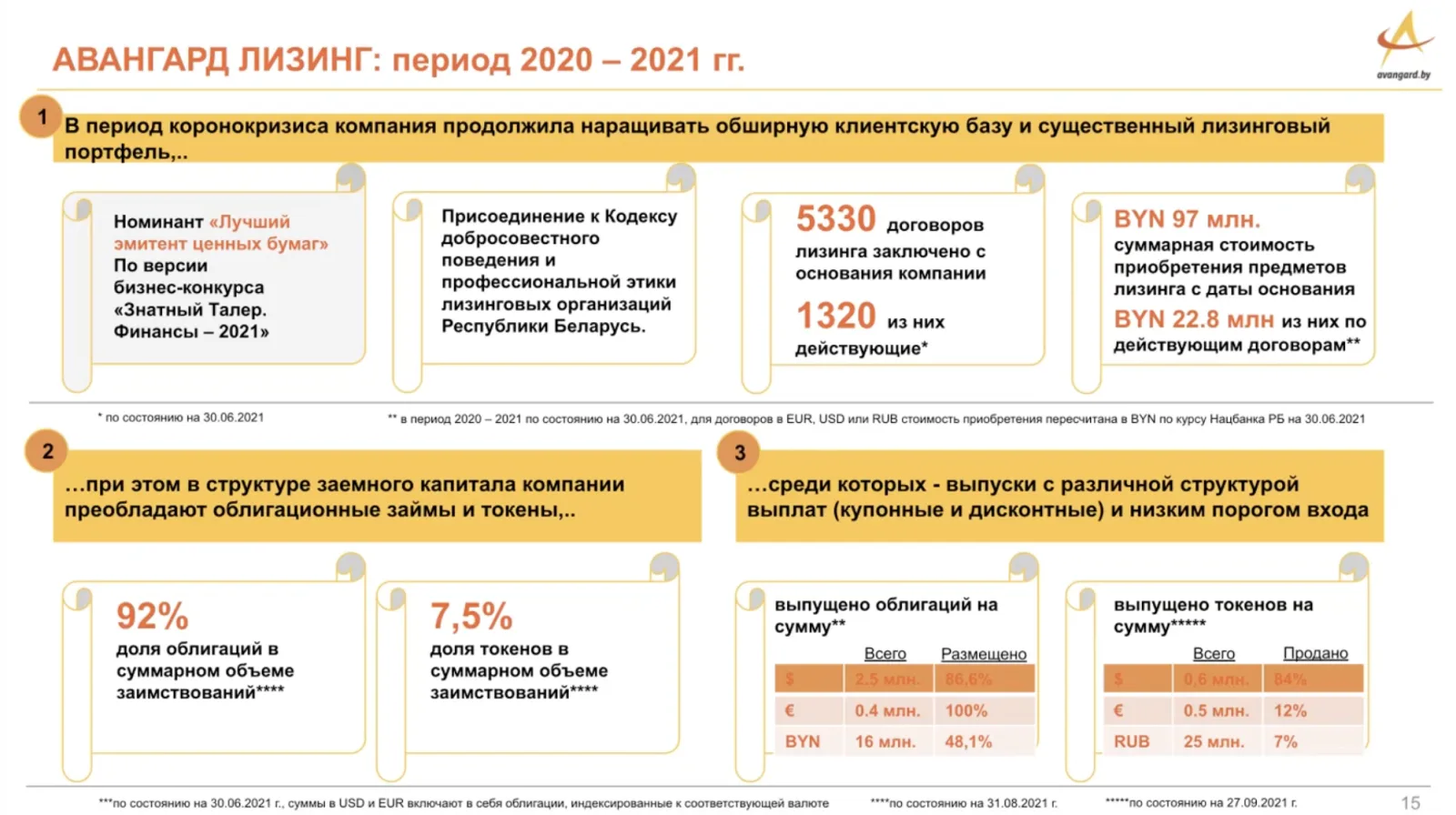
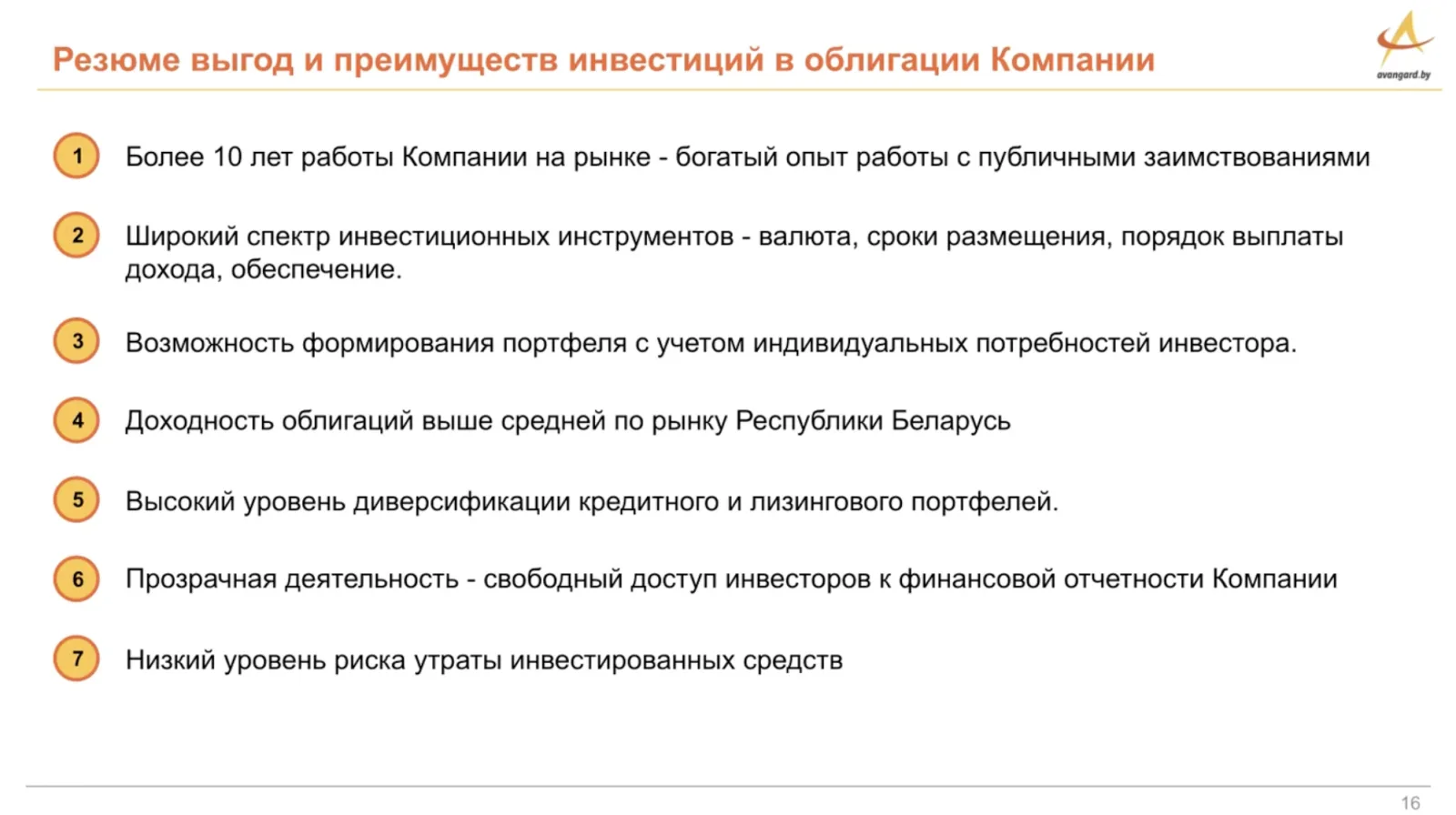
Summary
Presentation: “Indexed bonds”
With the ban on issuing bonds denominated in anything other than Belarusian rubles coming into force, the company has to think about how to raise the foreign currency it needs to fund obligations to lessees at acceptable prices. The company has experience issuing indexed securities.
Calculating monthly income on indexed bonds
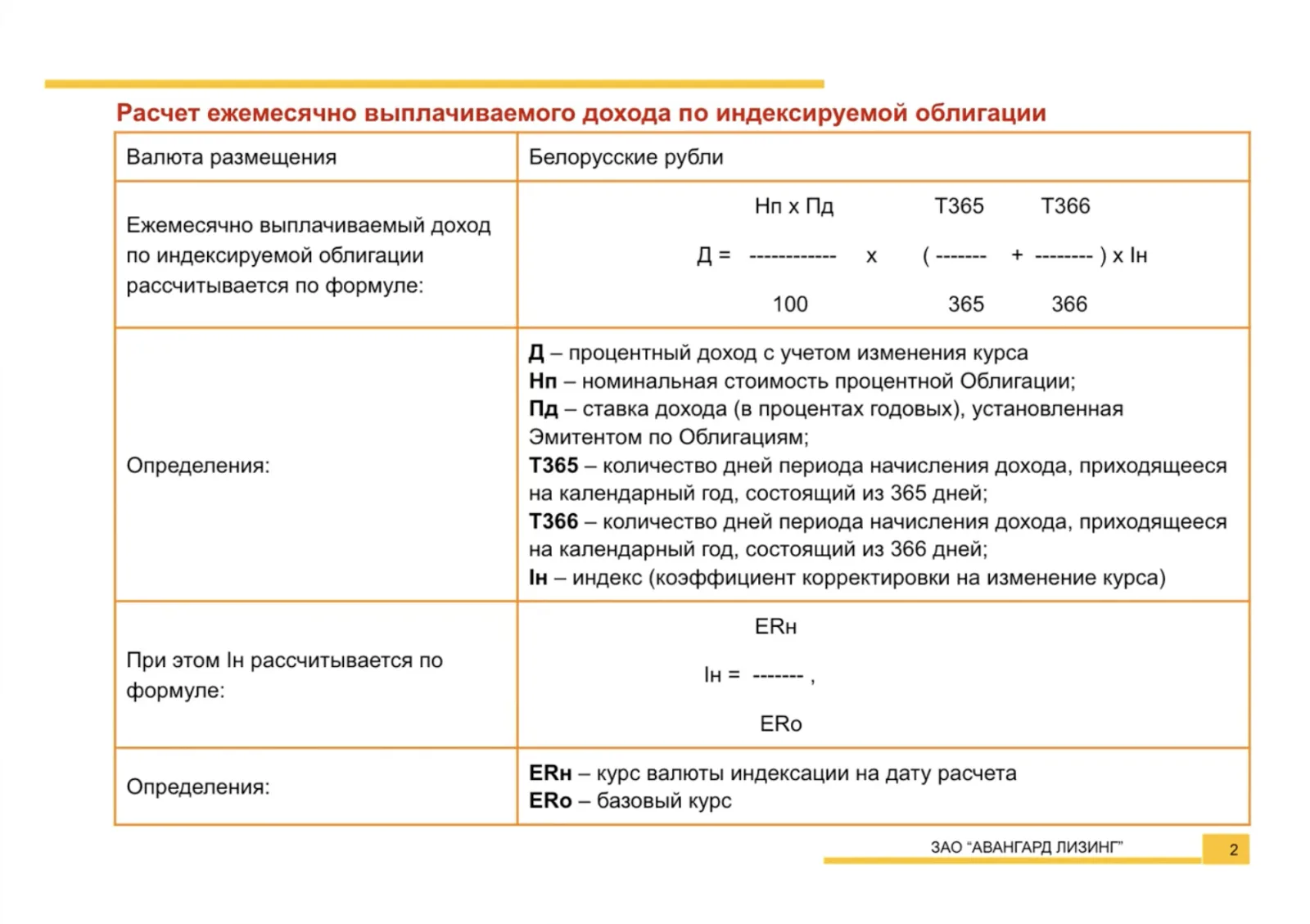
The formula for monthly income is the same as for interest-bearing bonds, except for the index In, which adjusts the bond's value to changes in the exchange rate. It is calculated as the ratio of the current exchange rate to the base rate.
Example of monthly interest income on indexed bonds
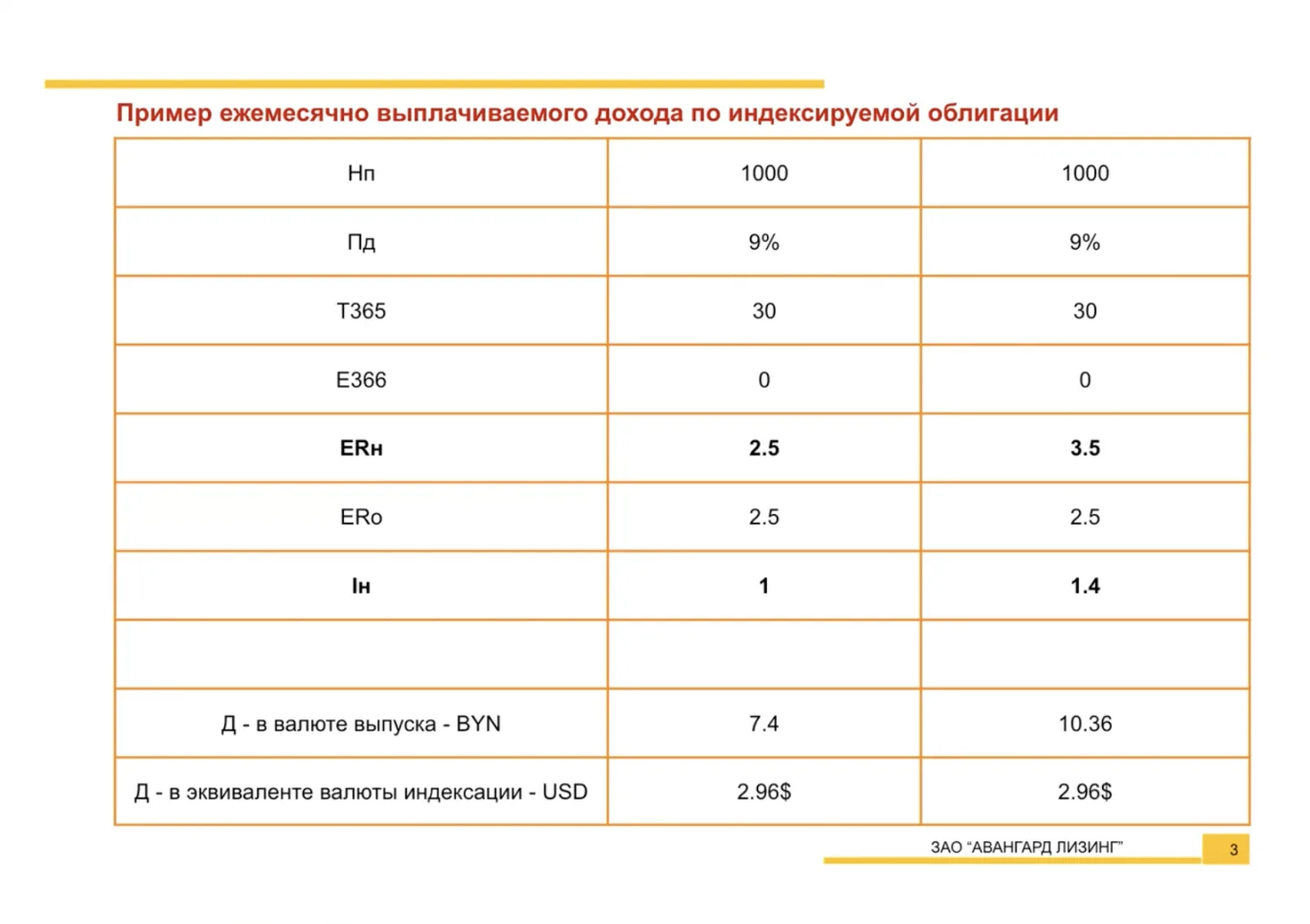
An example for a 30-day month with an index of 1 (no change in the exchange rate) and 1.4 (with a change). The amount of the payments in foreign currency stays the same regardless of the exchange rate.
Payment on redemption or buyback
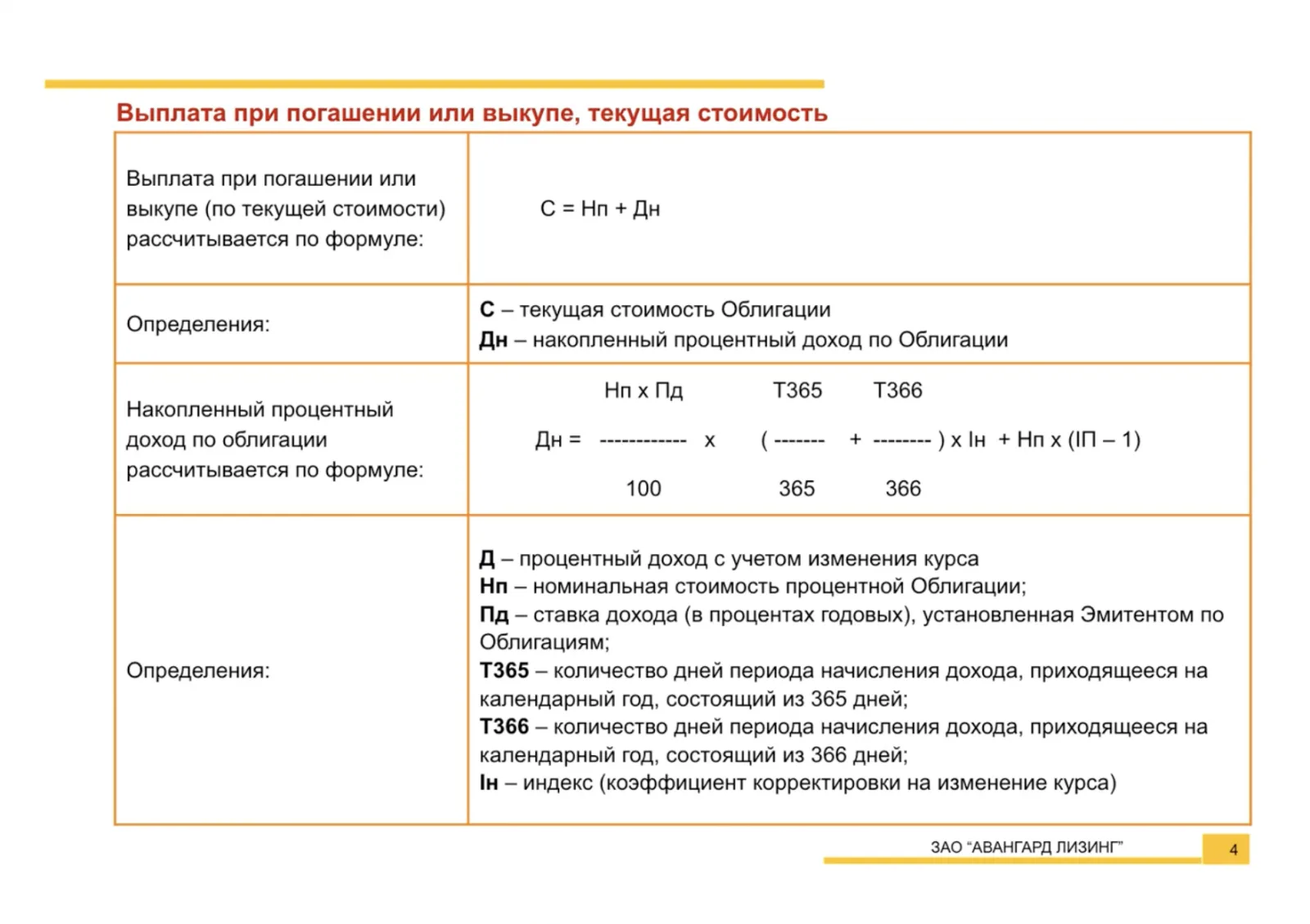
Example of payment on redemption or buyback
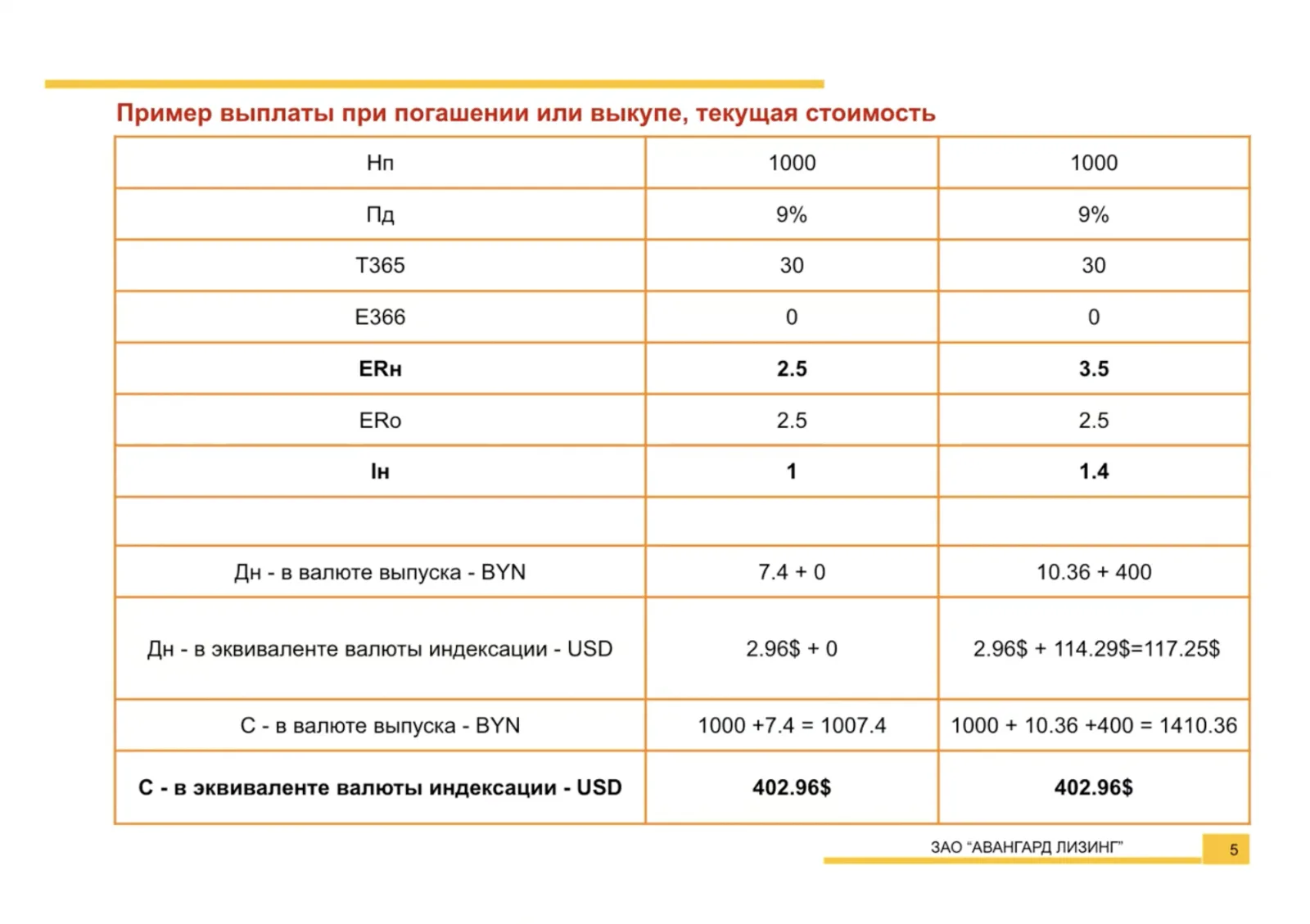
The right-hand column shows how the bond's value in US dollars changes as the exchange rate changes. The current value equals par plus accrued income.
The concept of indexed securities
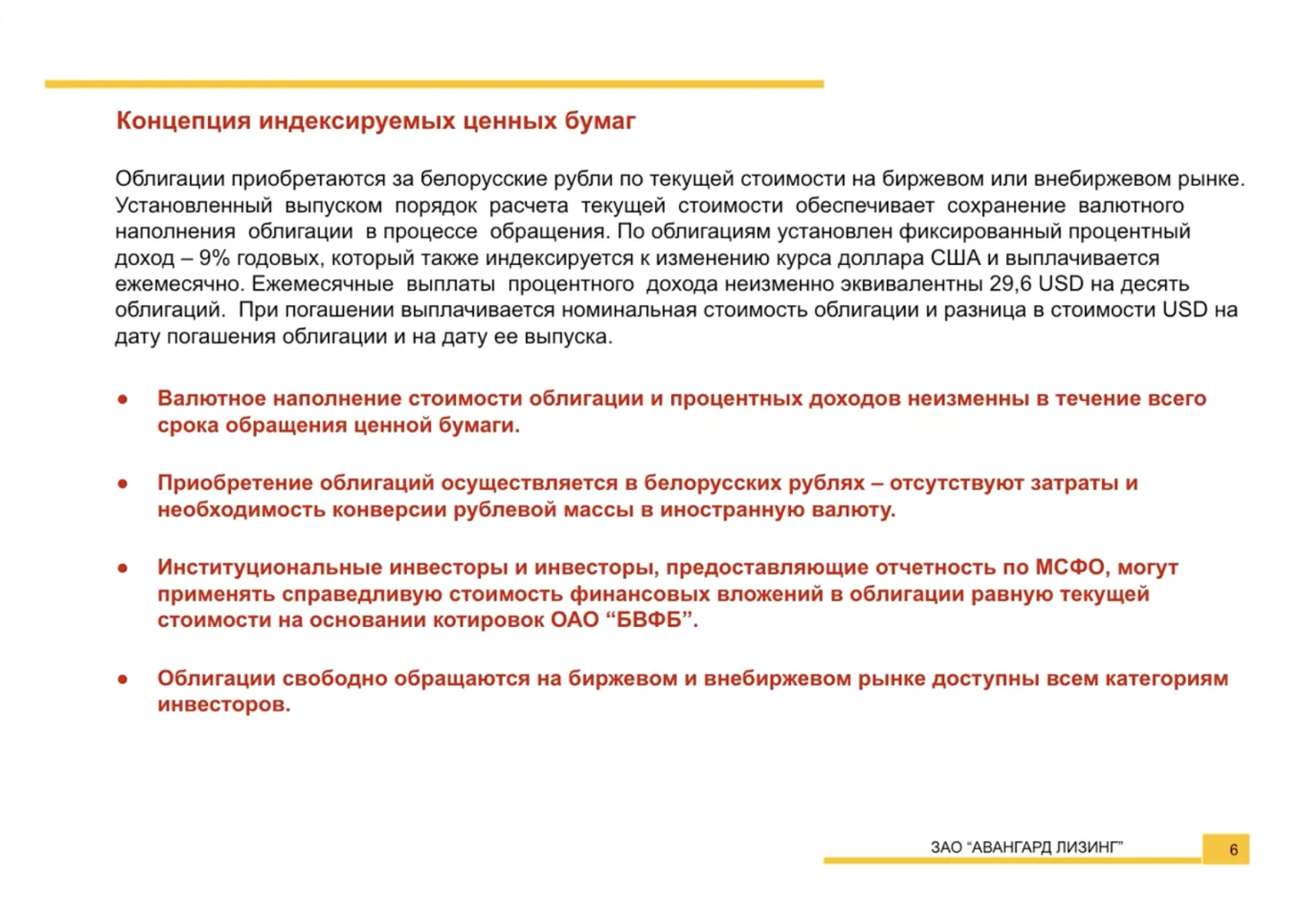
For an indexed security you can calculate the foreign-currency equivalent of its value, current and coupon income over the entire term of the bond. The variable income will change depending on the exchange rate on the payment date, but this does not affect the foreign-currency equivalent of the amounts paid.
The company has had such securities in circulation since 2014, and investors are satisfied.

Answers to investors' questions
- Will there be issues in Belarusian rubles, and at what interest rate?
The company is currently selling two ruble issues (exchange bonds no. 33 and 34): no. 33 is a discount bond, no. 34 interest-bearing. The interest-bearing bond yields 20% a year with monthly payments; the nominal yield on the discount bond is 27%. Both can be bought on the exchange now.
- How can I build a passive portfolio with stable, predictable monthly income?
The company does not build private portfolios. But since it issues in 4 currencies, investors can choose and combine as they like. As there are quite a few secured bonds on offer, some investors buy them and reinvest the monthly income at their discretion on Finstore at higher yields, diversified across different companies — there are plenty of issuers. And there are no transaction costs.
- Does Avangard Leasing CJSC plan to convert into an open joint-stock company and list its shares on the exchange?
The time for public capitalisation has not yet come, and now is not the best moment. But the possibility is being considered. The company is setting up governance bodies such as an independent board of directors and gradually developing its concept, since any public company needs a governance structure that meets the needs of a wide range of investors. The horizon is 5 to 10 years to create a company attractive to the market that can be recapitalised on the open market. The company is taking a very measured approach.
Questions from subscribers of our channel (t.me/binvesting):
- Your company has a fairly low return on equity (ROE) compared with other players in the Belarusian leasing market (19th of 27 in 2020). Why, and do you plan to fix it?
“We plan profitability within the existing legislation as instruments become available. We also respect and value our investors and offer attractive terms for placing funds with us, which also significantly affects return on capital. As for forecasts, yes, I believe that for 2021 and even more so in 2022 ROE may increase significantly, provided the capital a leasing company needs remains available at least at the current level.”
- How does the company plan to raise financing after the ban on FX bonds? Tokens, indexed bonds or something else?
“Bond loans already in circulation will not be affected, so we have capital for the next 3–5 years provided investor sentiment holds. To increase working capital we plan to keep borrowing in Belarusian rubles through exchange bonds and in foreign currency through token issues on the Finstore platform, and in the near future we plan to issue so-called indexed bonds secured by real estate, which we think will be an interesting alternative to FX bonds for investors.”
- What will allow the leasing industry to keep growing dynamically? What are the issuer's plans within the leasing market?
“Risks in leasing are much lower than in other forms of financing, so banks, for example, are actively converting their loan portfolios into leasing portfolios, either through direct leasing or by funding leasing subsidiaries. We still see demand for leasing significantly exceeding supply and will grow our leasing portfolio as funding becomes available. Our priority areas are consumer leasing and residential leasing.”
- What competitive advantages does your company have in the leasing market? How will you stay ahead of competitors in such an aggressive environment?
“Demand for leasing significantly exceeds supply, so competition exists only in some segments, such as car leasing. We avoid highly competitive segments and prefer high-margin, low-risk areas. Our undeniable advantage is versatility, which lets us meet almost any financing need of creditworthy clients.”
- How well diversified is your business — by geography, leased assets and lessees?
“I am not shy about saying that we are the most diversified leasing company in Belarus. You can see the level of diversification in the presentation available on the company's website.”
- What is the currency structure of your debt? Does the debt currency match the revenue currency, and to what extent?
“Our risk management policy does not allow a currency position, so we place funds in the currency of the loans and regularly rebalance our leasing portfolio. Currency imbalances arising from receivables are offset by the fact that repossessed leased assets keep their value in foreign-currency terms.”
- Your press release said the interest income is guaranteed. How is it guaranteed, and what are the main risks for investors in your bonds/tokens?
“All proceeds go to buying property that is then leased out with an obligation to buy it back, and it remains our company's property until the lessee has paid in full. Taking into account the 30% advance paid by the lessee when the lease contract is signed, the property costs AVANGARD 70% of its market price. The property itself, the large discount and the lease payment obligations of a pre-screened lessee are what guarantee interest payments and repayment of the bonds and tokens. In our view the biggest risks for investors are insufficient working capital for leasing operations, changes in the rules for leasing, the default of financial institutions used for settlements by our company and our clients, and other risks described in the issue documents for each loan.”
Translated from Russian. First published in the “Belarusian Issuers” Telegram channel. Charts and screenshots are in Russian. This is not investment advice.