Cbonds conference on the Belarusian debt market
Overview
On Friday 19 March, Cbonds held its 6th round table “Debt Market of the Republic of Belarus”. The conference discussed the macroeconomic outlook for Belarus and the most important trends in the financial market.
Key takeaways
- FX bonds will be replaced by indexed bonds in Belarusian rubles (ruble bonds linked to the US dollar exchange rate). This was confirmed both by the Ministry of Finance and by brokers.
- Alfa-Bank is unlikely to cut fees on order-based asset management in the near future and will focus on improving its service.
- The sharp fall in key macroeconomic indicators in Belarus has stopped, and experts do not expect shocks in the short term, including on debt payments. However, the long-term outlook is unclear, and without systemic economic and political change the forecast is not very positive. Business expectations are largely negative.
- Over the past year the number of retail investors in Russia has grown several times over. This is especially relevant for Belarusian companies planning to borrow on the Russian market, since Belarusian bonds usually offer high yields and are in particularly high demand among private investors.
- Eurotorg has become a benchmark on the Russian market and was cited by most speakers as “a consistently successful Belarusian bond issuer on the Russian market”.
Below is a brief summary of the speakers' presentations, highlighting the most important points.
Trends in the Belarusian financial market
Pavel Korzik, head of investments, Alfa-Bank
People interested in buying foreign securities often ask whether Alfa-Bank will cut fees on order-based asset management. We put exactly this question to Alfa-Bank and got the following answer: “At the moment we are limited by transaction volume. Foreign brokers have much larger volumes and therefore get better terms from partners. As the number of clients grows, we will also be able to cut costs and offer lower fees. Right now our priority is improving the quality of our service.”
Here are a few interesting slides from Pavel's presentation.
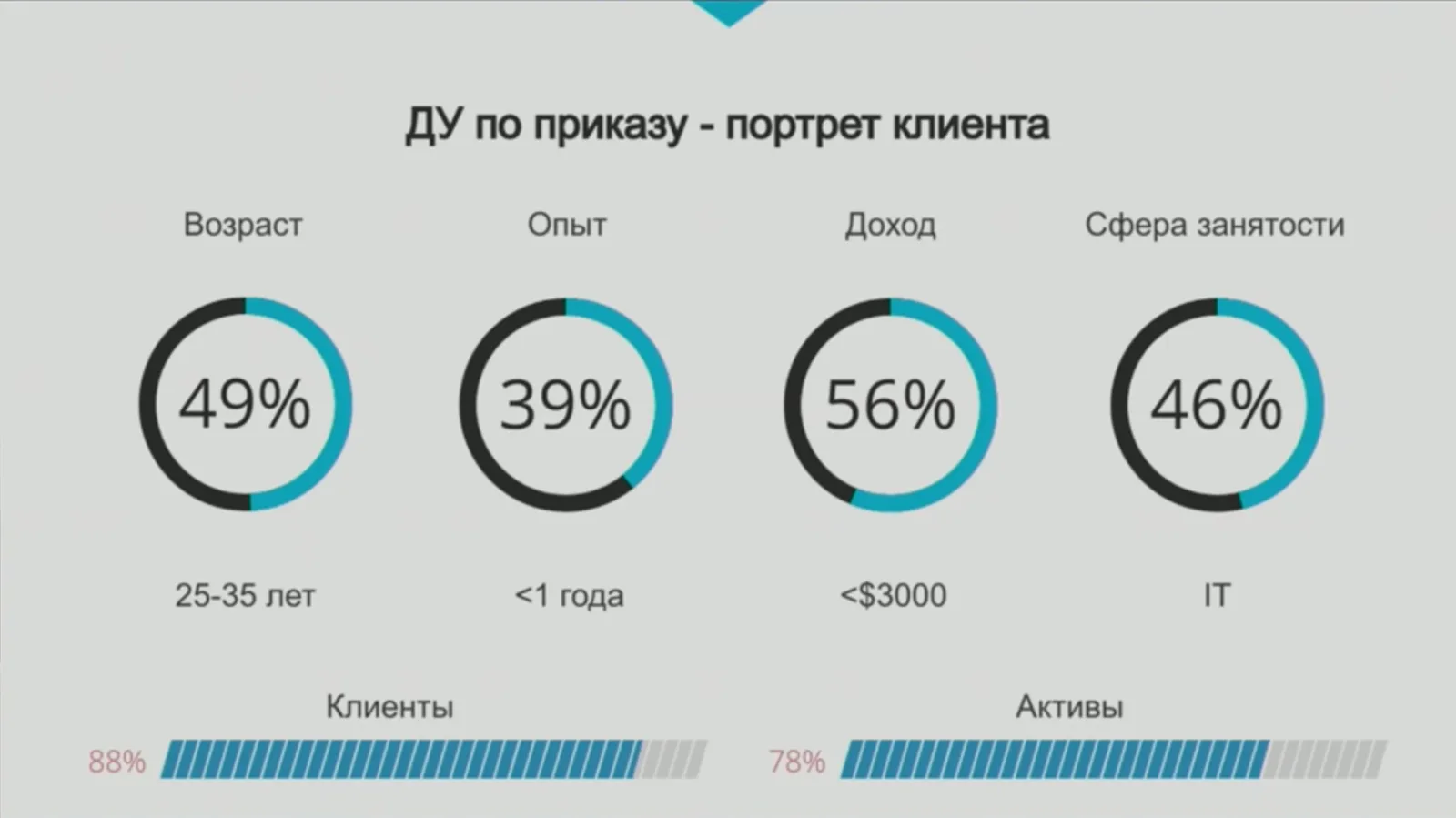
Profile of an order-based asset management client at Alfa-Bank:
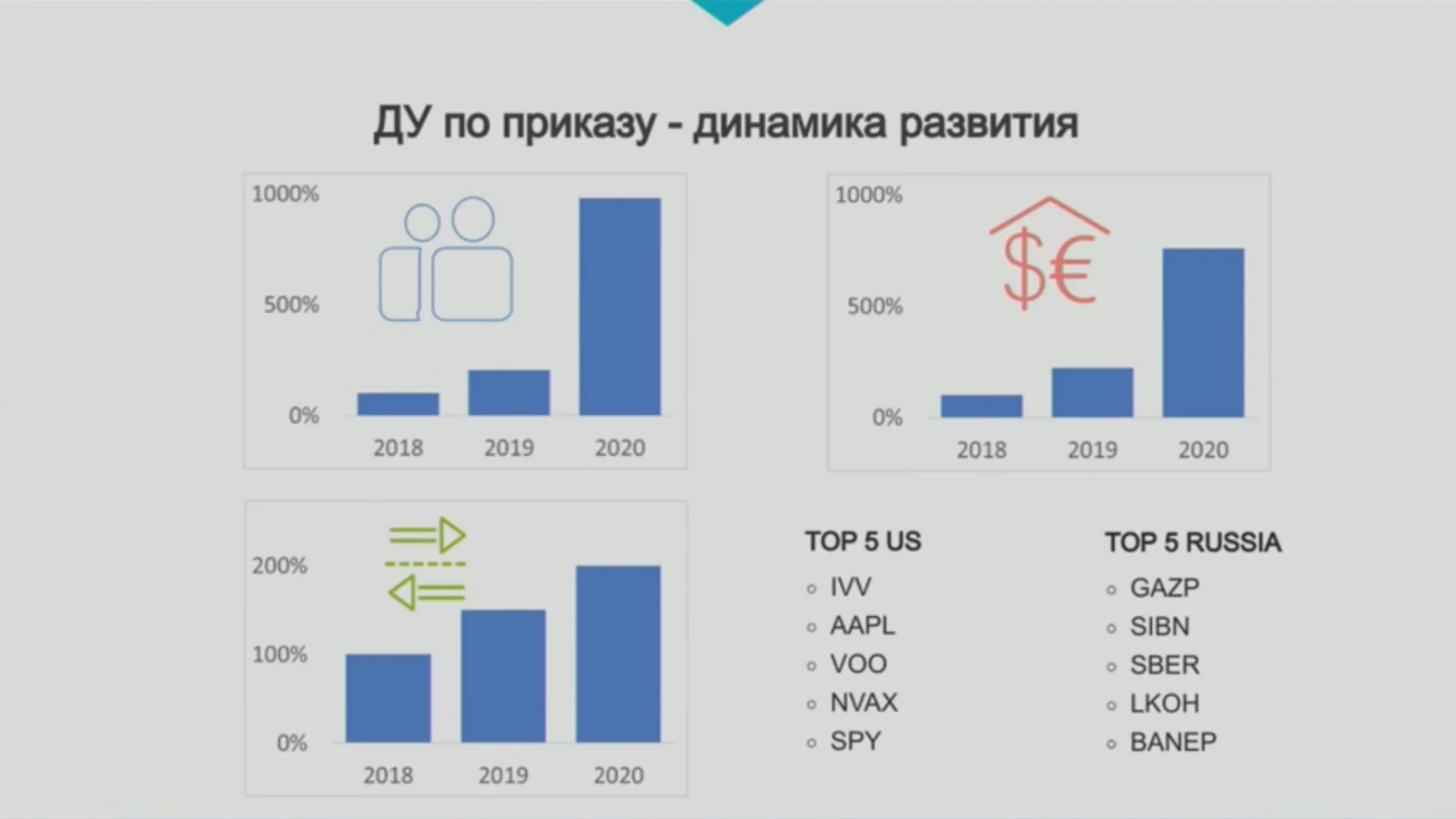
As the next slide shows, the number of order-based asset management clients at Alfa-Bank grew tenfold from 2018 to 2020. The list of the most popular securities among Belarusians is also pleasing, with plenty of diversified ETFs.
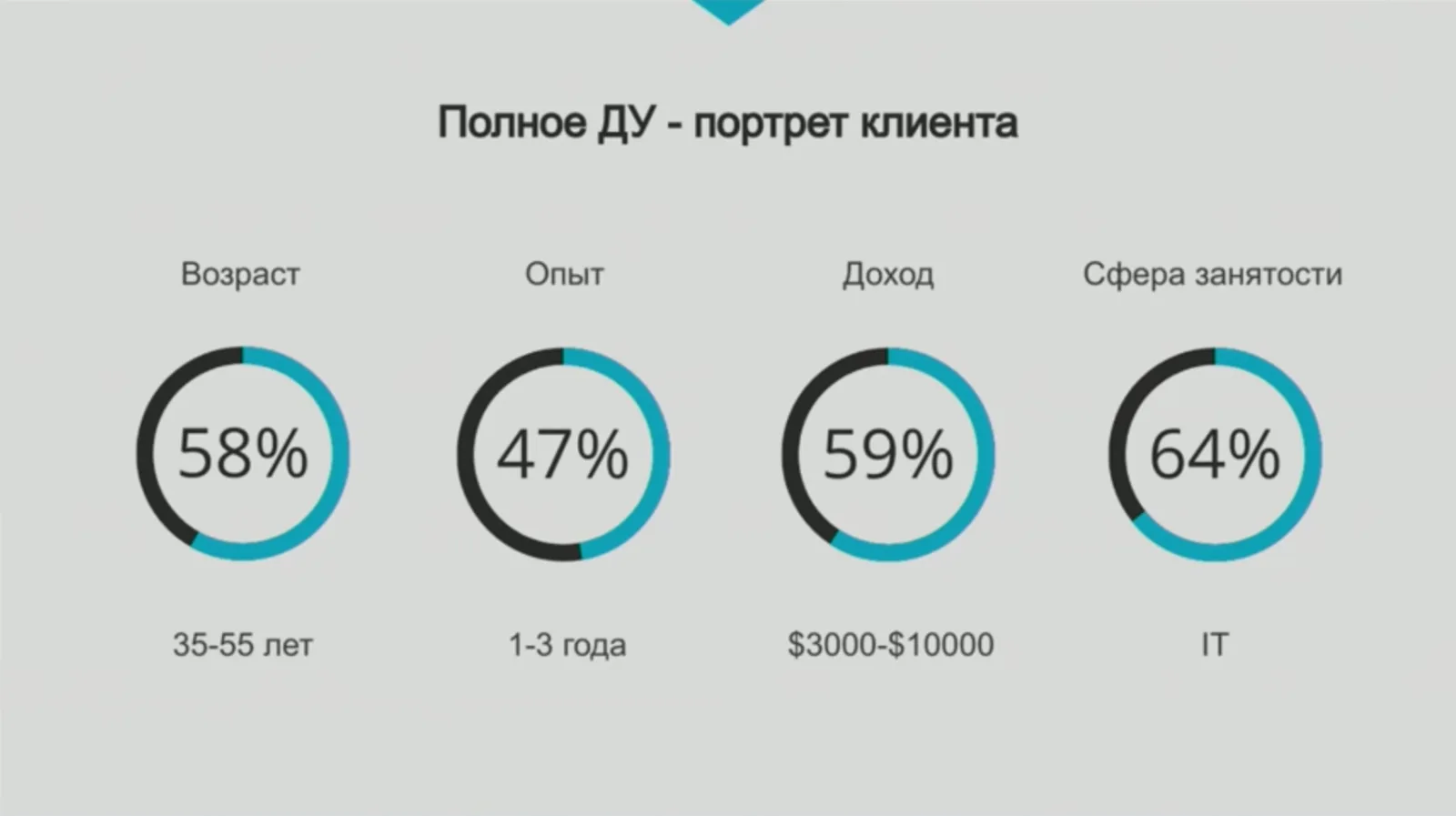
Profile of a full-mandate asset management client at Alfa-Bank:
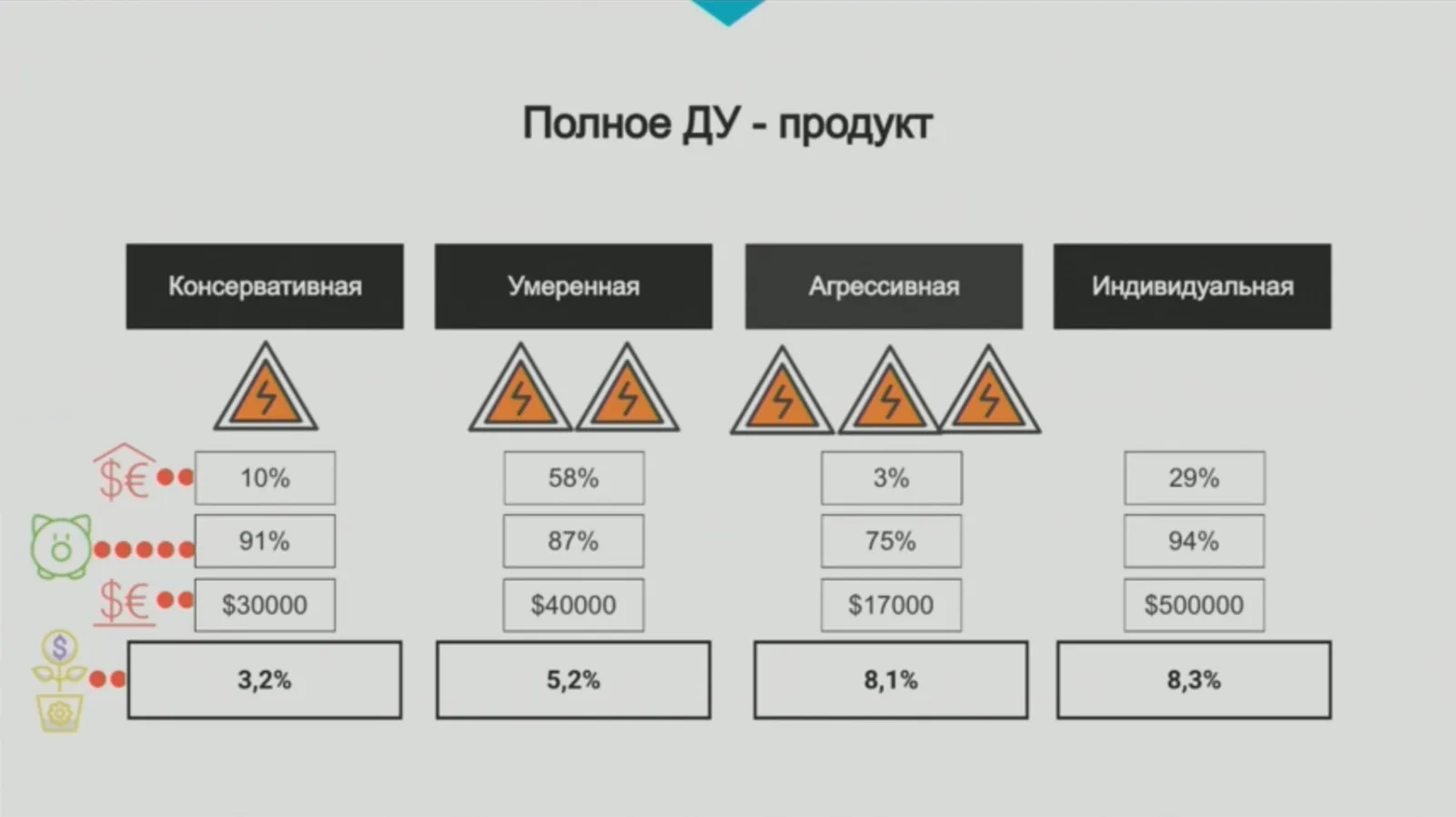
Below are full-mandate statistics by strategy. The first column is the share of funds in a strategy, the second the share of profitable portfolios, the third the average portfolio size, the fourth the average annual return.
Veronika Sankovich, director of ASB Broker
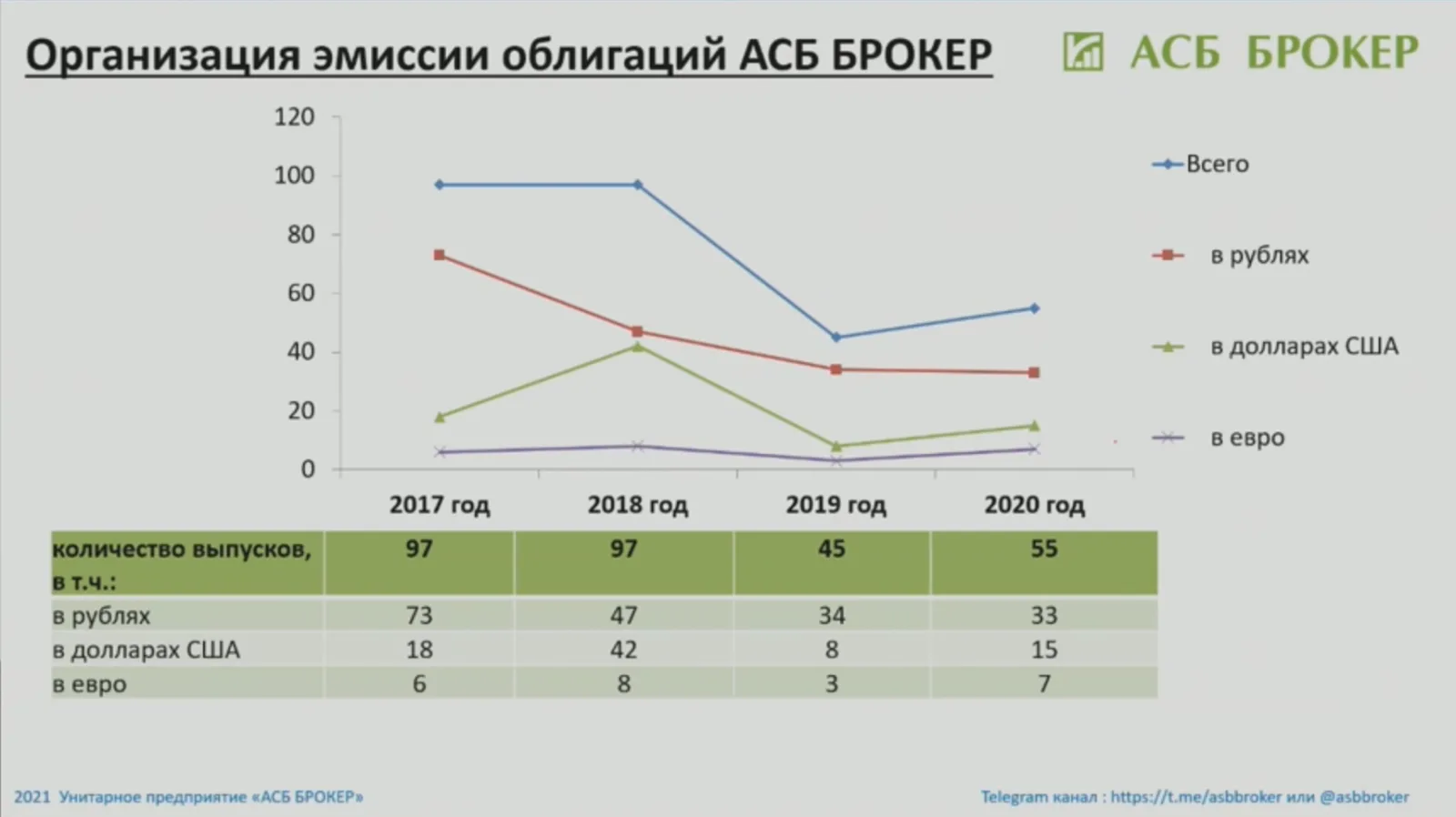
In her presentation Veronika Sankovich pointed directly to double standards for bonds and tokens. On the other hand, lighter regulation of tokens should not necessarily be seen as an advantage for buyers: issuing tokens requires meeting fewer standards, so tokens are often issued by companies that did not qualify to issue bonds. At the end of 2018 the National Bank of Belarus abolished the possibility of trading issuers' corporate securities for foreign currency. Veronika showed a clear chart of how this restriction led to a sharp drop in the number of issues in 2019:
Veronika also shared useful information on defaults. The next image lists defaults up to 2020; bonds sold to retail investors are highlighted in red:
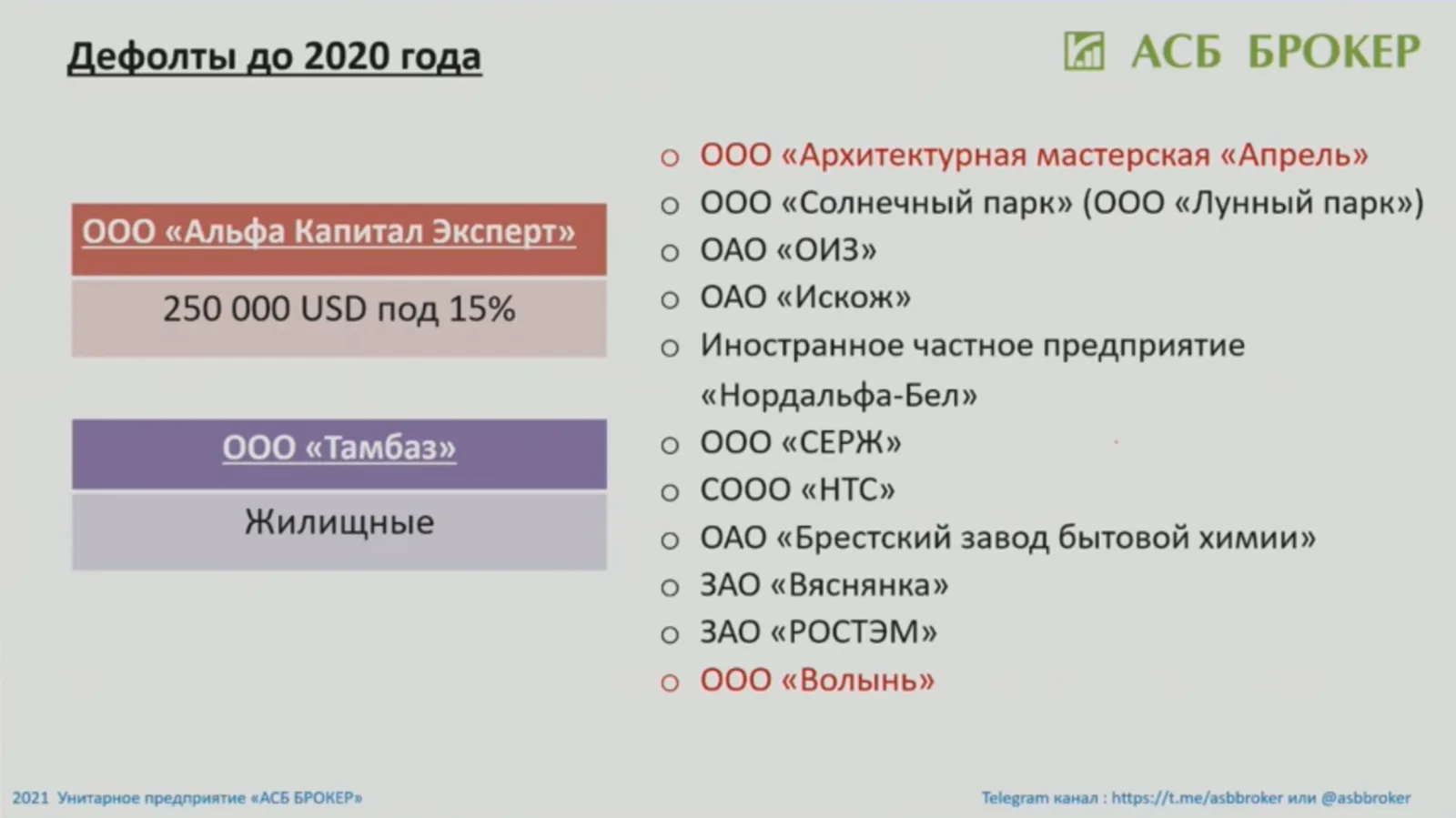
Since 2020 several companies have defaulted on bonds:
Polimiz OJSC
Importstroymaterialy LLC (bonds bought back by SanPlit)
Zhilstroykomplekt LLC
Drilling company “Delta” OJSC (obligations met on 5 October 2020)
Anatoly Sharshun, director of the securities department, Ministry of Finance
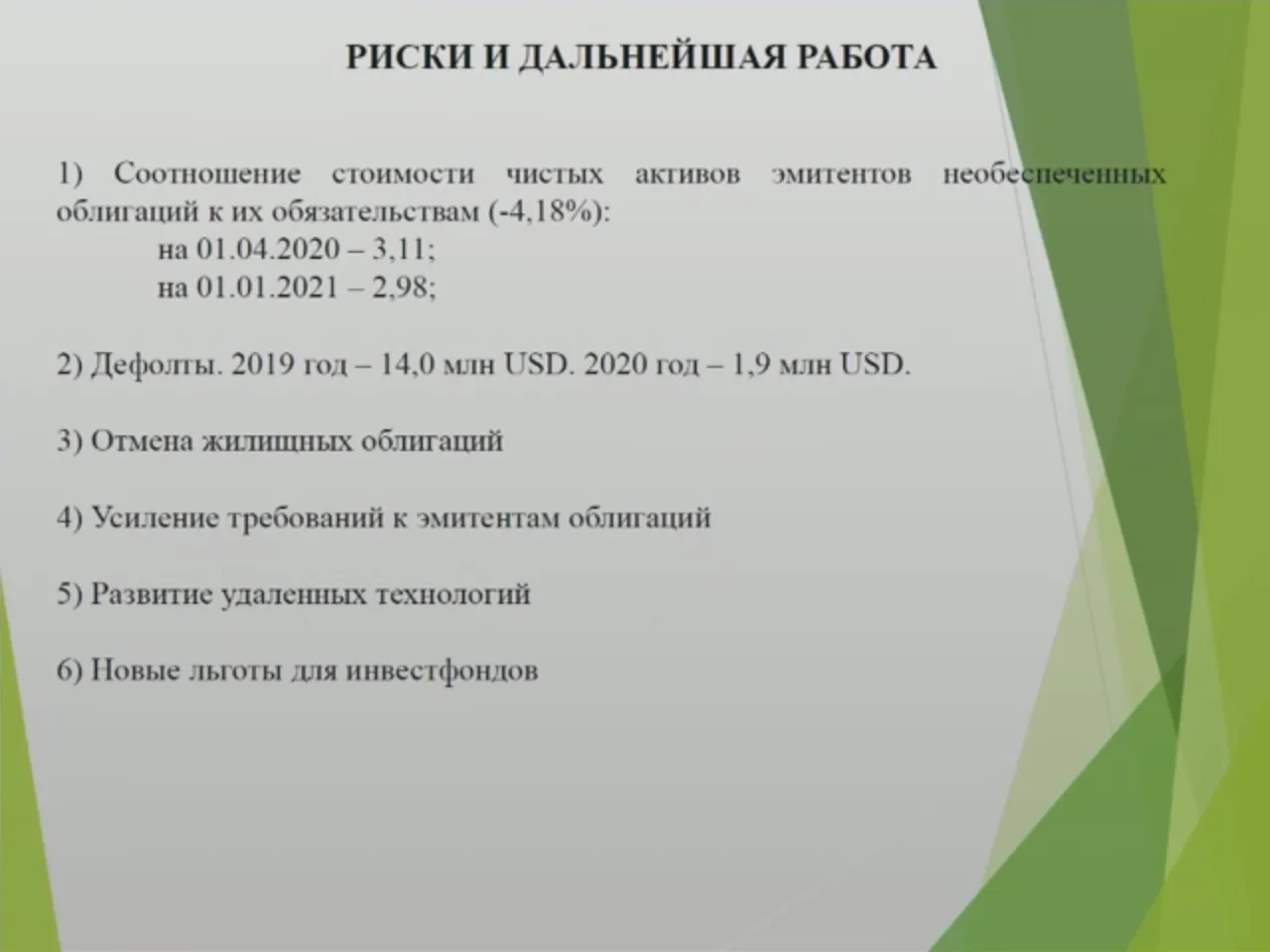
He noted a slight decline in activity on the Belarusian financial market. The ban on issuing bonds denominated in foreign currency was described as a necessary step in Belarus's de-dollarisation policy. Anatoly confirmed that FX bonds will be replaced by indexed bonds in Belarusian rubles. Housing bonds are also to be abolished. Key points from the Ministry of Finance:
Alexander Makovetsky, director of Finup24
A new player with a new platform for buying securities is actively entering our market. How is Finup better than existing players, namely Aigenis and Laserta? We asked Alexander exactly that and got this answer: “Both brokers you named offer a single product: Aigenis the exchange segment, Laserta the OTC segment. We want to offer a product that covers both. Moreover, those brokers only have a mobile app, while we also offer a web version.”
Boris Fridman, deputy chairman of the BCSE management board
The exchange has introduced the QUIK system for real-time trading, and soon brokers will be able to give clients access to exchange trading through QUIK.
Elena Yanchenyuk, ASB Leasing
Half of ASB Leasing's borrowings are funded by bonds, 65% of which were sold to Belarusbank. ASB Leasing decided to issue tokens because of the upcoming ban on FX bonds.
Macroeconomic review
Olga Tarasevich, deputy Minister of Finance
Planned economic growth in 2021 is 101.8% of GDP. Target inflation is 5.5%, the refinancing rate 7.75%. The 2021 national budget was planned with a deficit of BYN 4 billion (2.5% of GDP), but taking into account measures already adopted to support certain enterprises during the pandemic, the revised deficit is BYN 5.6 billion (3.5% of GDP). The deficit is again to be financed from budget balances and new government borrowing. In 2020, USD 2.5 billion was spent on stabilising the national currency. The borrowing plan for 2020 was exceeded.
Alexander Chubrik, director of the IPM Research Center
Alexander shared the results of research on the business environment in Belarus and outlined the economy's general problems.
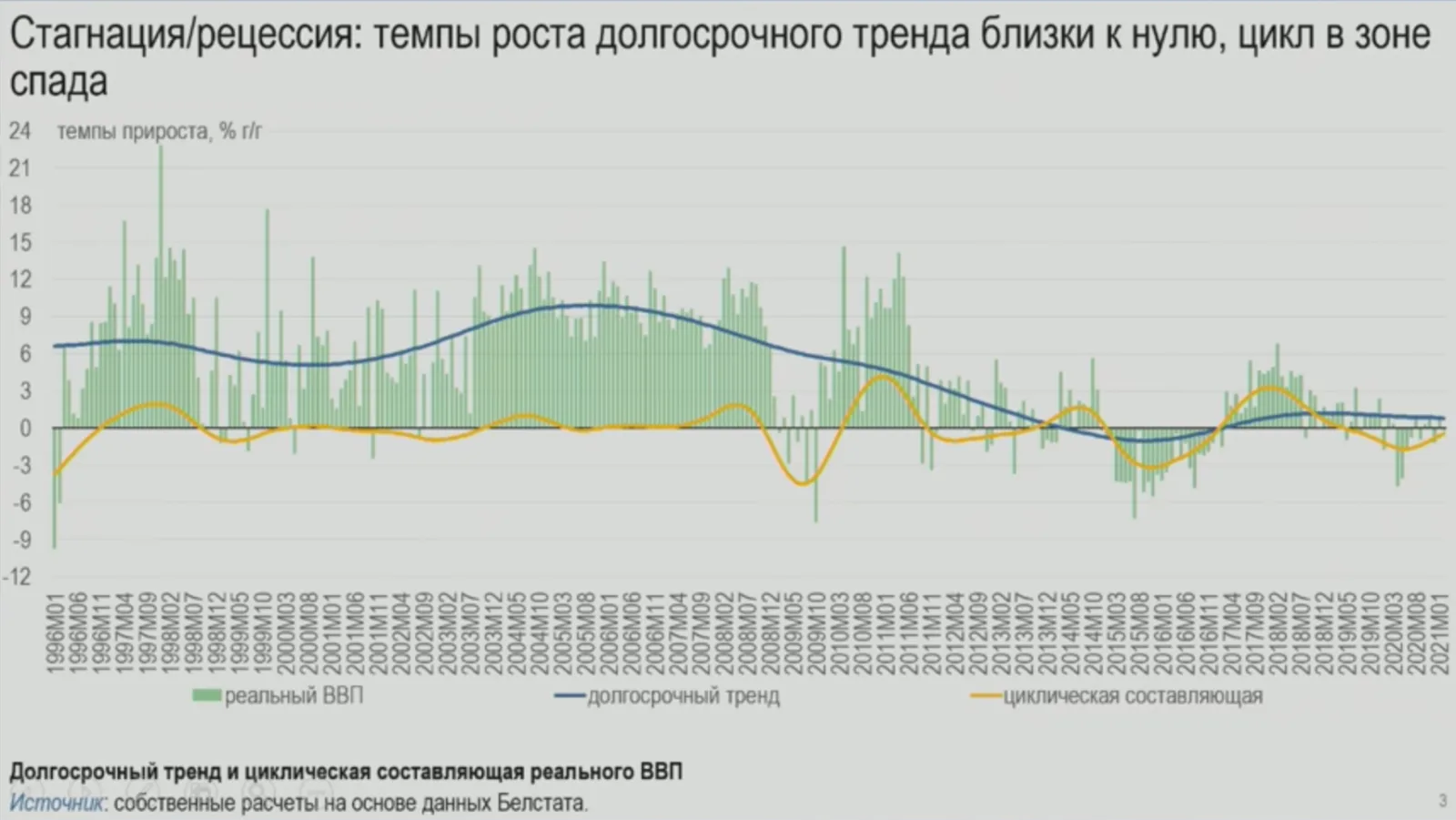
A chart showing long-term changes in GDP is of interest:
These are the main problems businesses currently see for their operations:
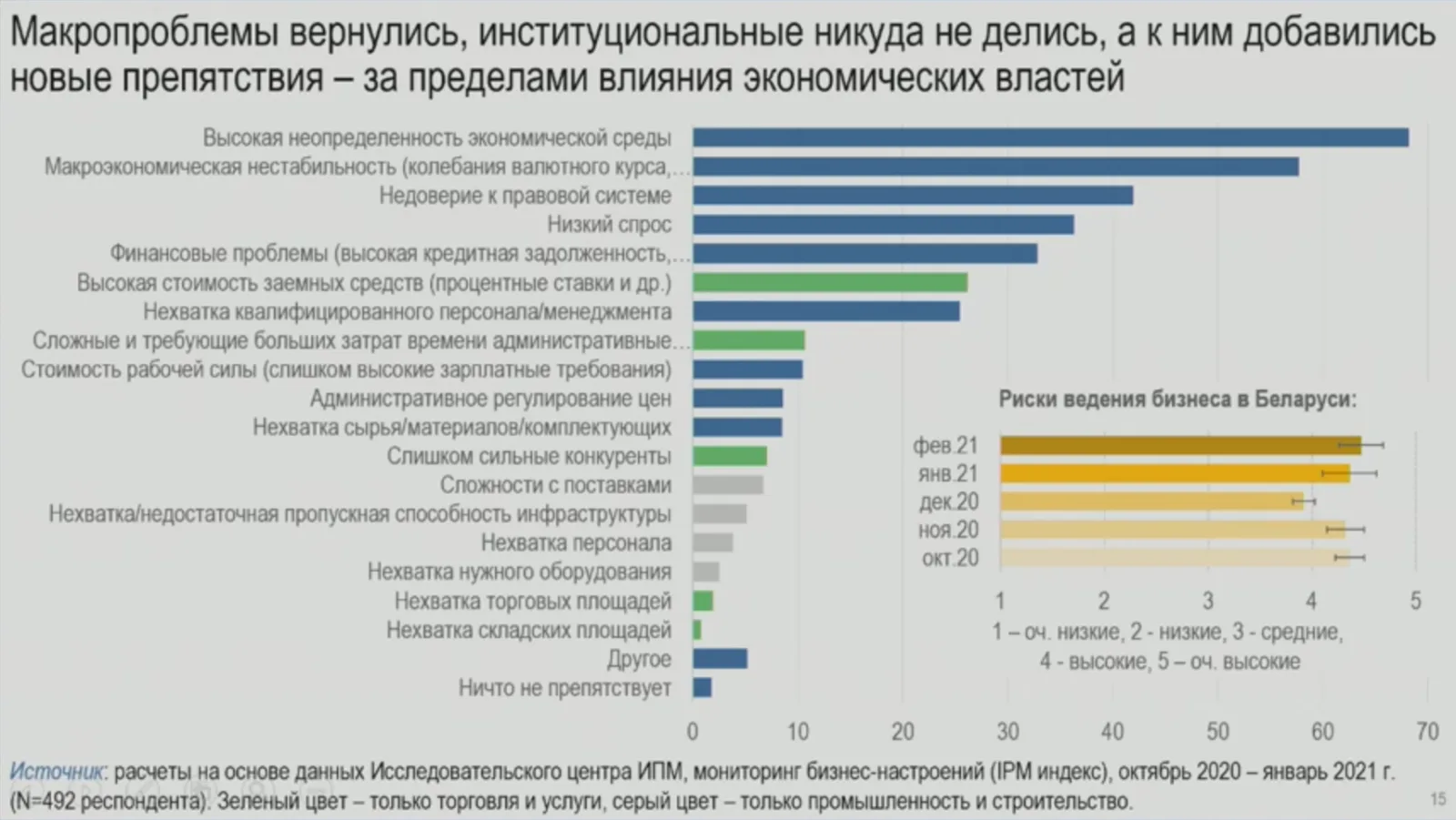
Overall, companies look to the future with pessimism and expect the situation to worsen further.
The problem of raising borrowed funds has become much more acute:
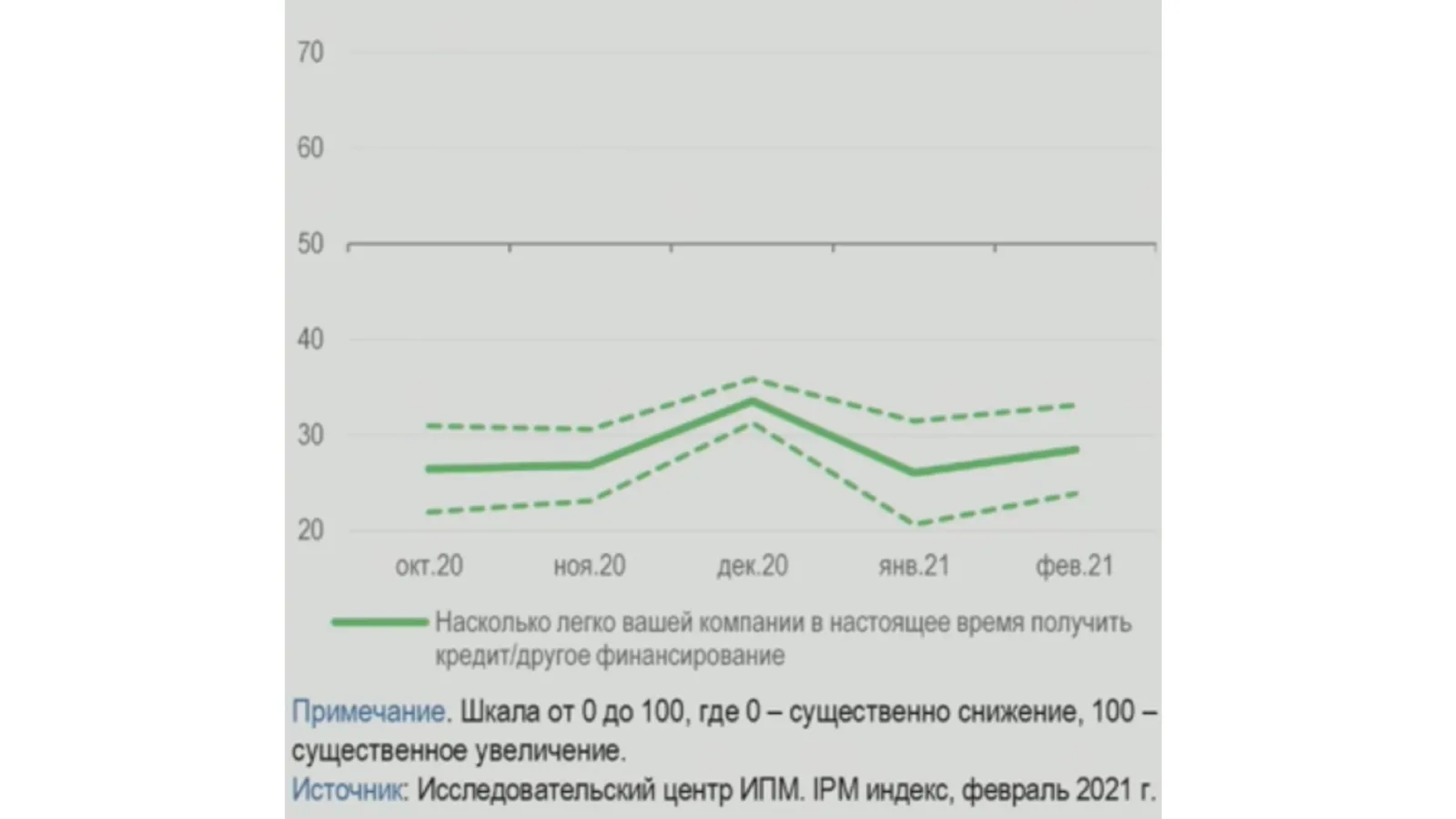
Businesses expect high inflation as well as falling demand and output.
On the positive side, companies do not plan significant staff cuts.
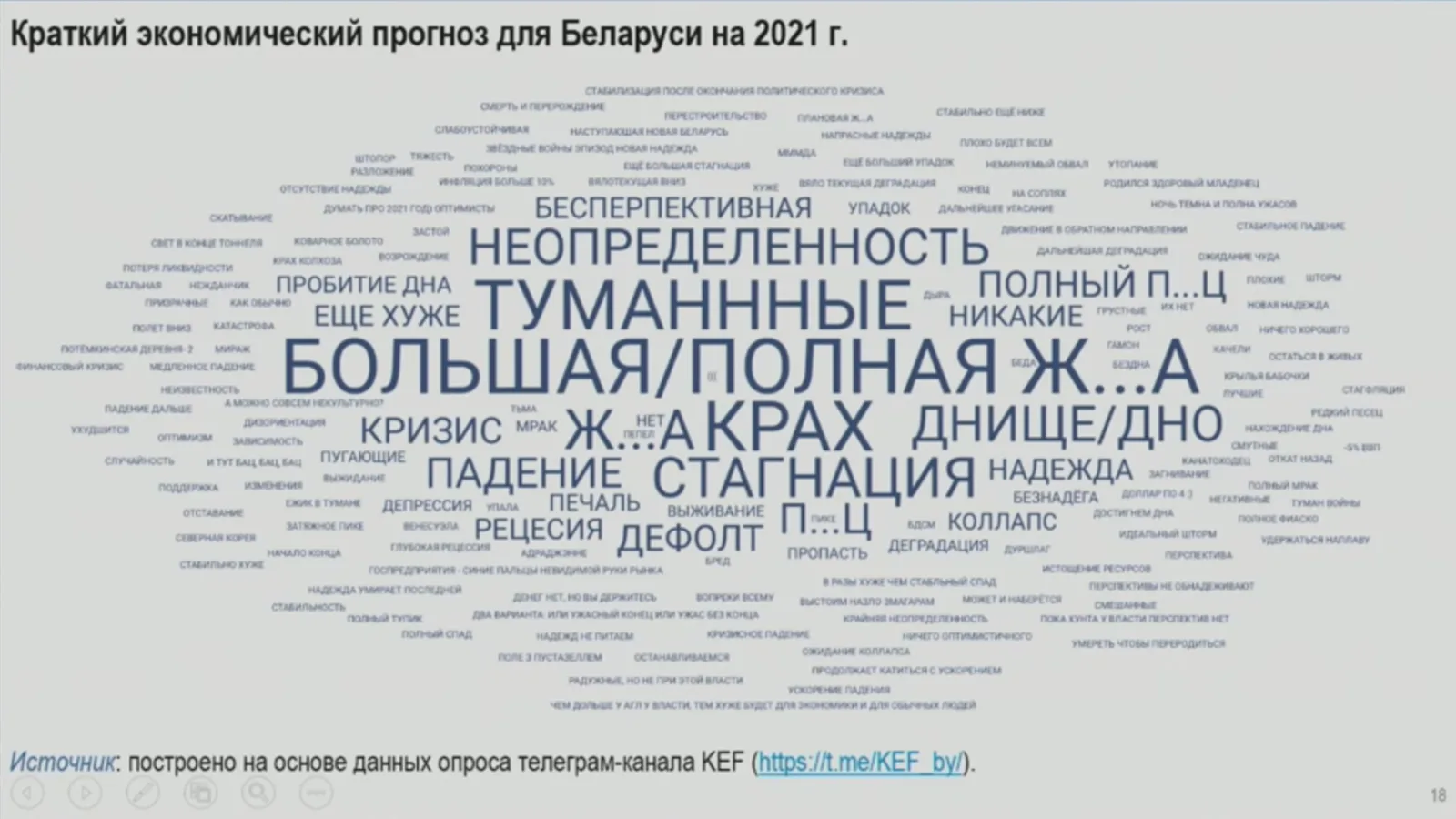
And of course the now legendary slide with the most popular words describing business expectations for 2021:
Presentations by Russian colleagues
Macroeconomic review
The Russian colleagues largely repeated the points made by the Belarusian speakers, but left out the negative part. There are indeed positives: the sharp fall in macroeconomic indicators has stopped, international reserves have stabilised, the outflow of deposits has stopped, and in December ruble deposits even grew. Belarus is unlikely to have problems servicing its debt in 2021, as reserves are still relatively high. Gazprombank forecasts Belarusian GDP growth of 2% in 2021.
Gazprombank does not expect a downgrade of Belarus's credit rating, since the main factors that led the key rating agencies to change their outlook to “negative” — the sharp deposit outflow and the sharp fall in reserves — have stopped.
The retail investor boom in Russia
The number of retail investors grew by more than 5 million in 2020, reaching 8.8 million at year-end. By the end of February 2021 it exceeded 10 million. Experts attribute this mainly to the recent fall in deposit rates.
Rating agencies
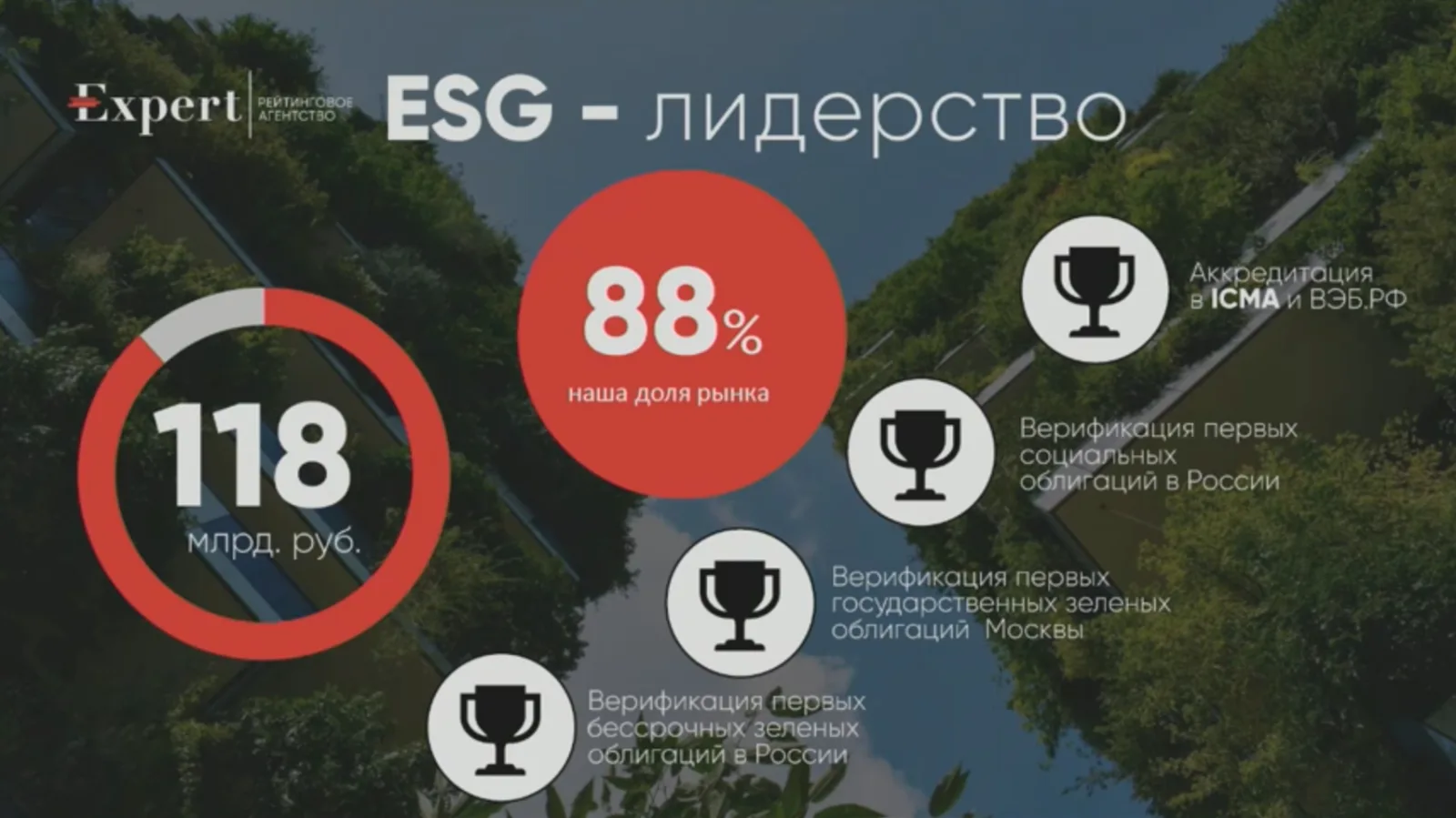
Representatives of the Russian rating agencies Expert RA and ACRA attended the event. They mostly explained how they can assign ratings to Belarusian companies on the Belarusian national scale and then convert them to the Russian scale. A credit rating is required to place bonds on the Moscow Exchange.
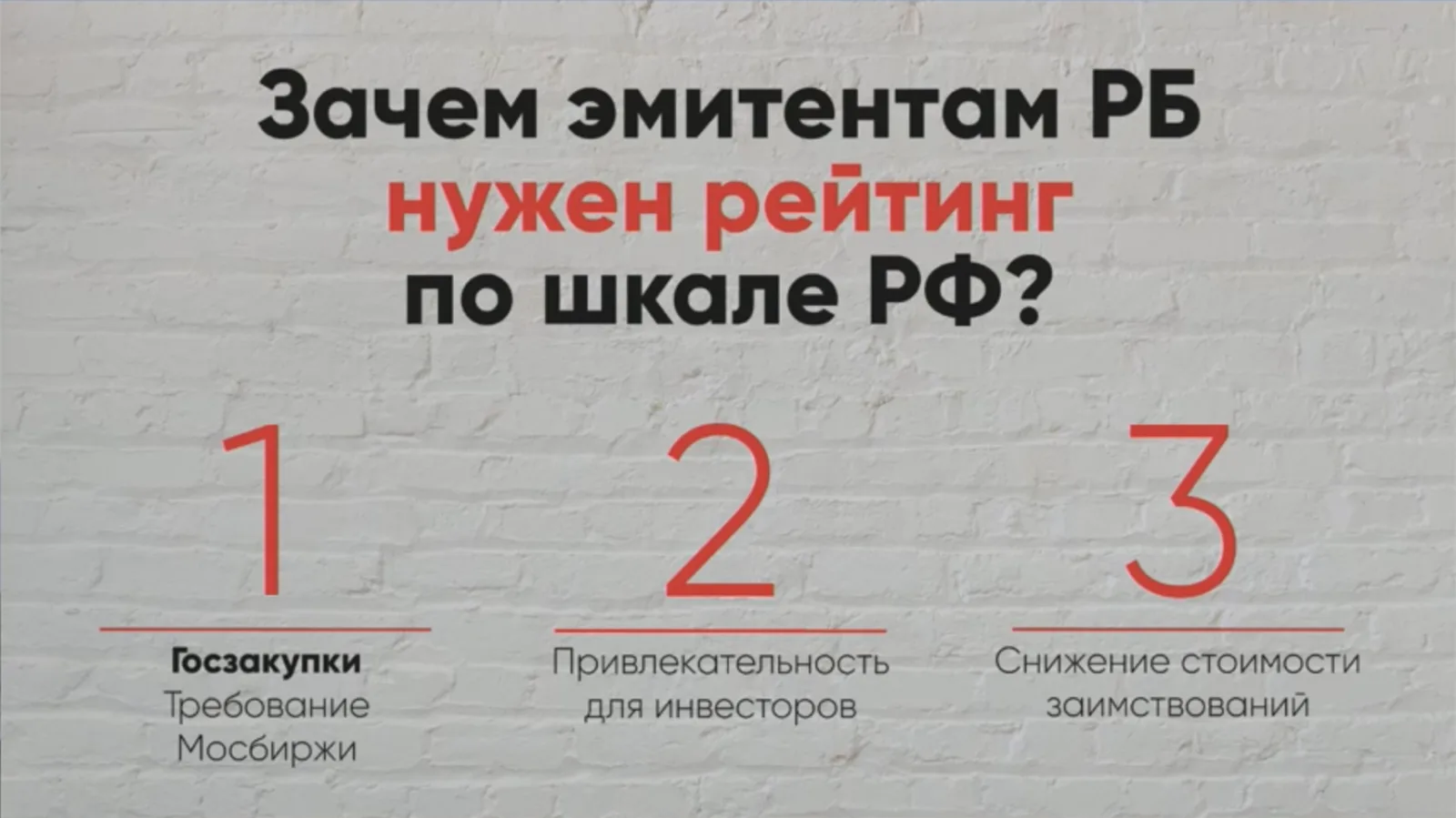
Expert RA put a strong emphasis on a new product: ESG verification of green bonds.
Translated from Russian. First published in the “Belarusian Issuers” Telegram channel. Charts and screenshots are in Russian. This is not investment advice.